2026 Global Nature Finance Report
The United Nations Environment Program (UNEP) releases 2026 Global Nature Finance Report, which aims to summarize the status of global nature finance and provide development recommendations.
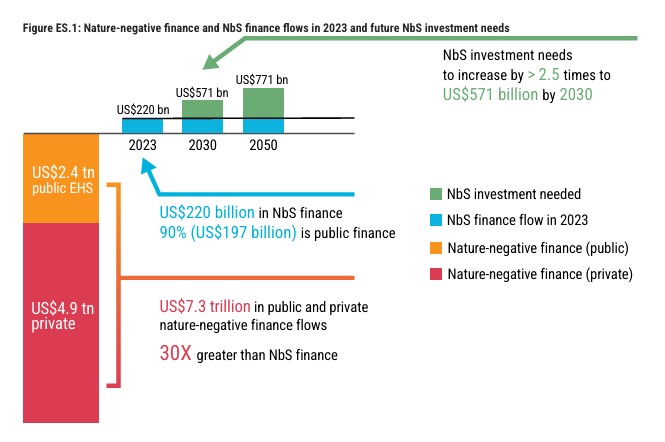
The United Nations Environment Program believes that the global funding for negative impacts of nature reaches $7.3 trillion annually, while the funding for positive impacts is only $220 billion annually, with a gap of over 30 times. Narrowing this gap is an important way to solve the problem of nature finance.
Related Post: World Bank Releases Multilateral Development Banks Nature Finance Taxonomy
Global Status of Nature Finance
At least half of the global economy is moderately or highly dependent on nature related services, and human awareness of nature dependence, impacts, risks, and opportunities is increasing. Currently, nearly 180 financial institutions worldwide have adopted the Taskforce on Nature-related Financial Disclosures (TCFD) framework to disclose information, with assets accounting for over $22.4 trillion. Global nature finance can be divided into two categories, namely:
- Natural negative impact funds: Funds that harm nature, including public financing ($2.4 trillion) and private financing ($4.9 trillion). Public financing mainly includes environmentally harmful subsidies, while private financing mainly involves industries such as public utilities ($1.58 trillion) and industry ($1.38 trillion).
- Natural positive impact funding: Financing for nature-based solutions, including public financing ($197 billion) and private financing ($23.4 billion). Public financing is mainly invested in biodiversity conservation (82.2 billion US dollars) and sustainable agriculture (66.3 billion US dollars), while private financing is mainly invested in biodiversity compensation (7.1 billion US dollars), sustainable bonds (5.1 billion US dollars), and commodity supply chains (4.6 billion US dollars).
To achieve the goal of the Global Biodiversity Framework (to protect 30% of the world’s land and oceans by 2030) and the Paris Agreement’s global 1.5-degree Celsius warming target, global funding for positive impacts on nature needs to reach $571 billion by 2030 and $771 billion by 2050. There is a huge gap compared to the current financing scale of 220 billion US dollars.
How to Expand Global Nature Finance
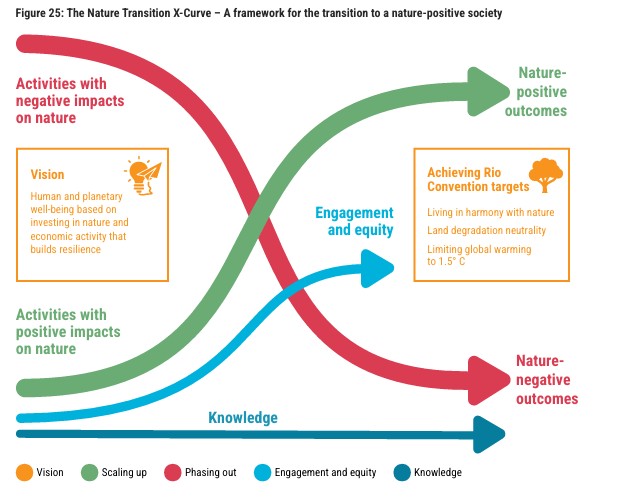
The United Nations Environment Program has proposed the Nature Transition X-Curve, which aims to gradually reduce funding for negative impacts of nature and gradually expand funding for positive impacts of nature. The actions involved in the natural transition X-curve include:
- Developing a vision: Comprehensively address biodiversity and natural issues and develop a nature finance plan.
- Phasing out nature negative finance: Reduce subsidies and incentives that are harmful to nature, while providing training, assistance, and other measures to support just transition.
- Scaling finance for nature positive outcomes: Expand the role of private capital in natural investment and supporting the development of green financial instruments related to nature.
- Engagement and equity for right holders: Enhance the position of stakeholders in the design and implementation of natural solutions, ensuring that nature finance is in line with local ecology and culture.
- Knowledge: Strengthen the application of data and knowledge systems, track the progress of nature finance, and promote natural positive impact investment in the market.
The United Nations Environment Program provides the following recommendations to market participants:
- Regulatory agencies: Incorporate natural values into fiscal budgets and plans, require companies and financial institutions to disclose nature-related risks and impacts, and reduce negative natural impact funds.
- Enterprises and financial institutions: Assess and disclose the impact of their business and investment portfolios on nature, develop and implement natural positive transition strategies and action plans, actively invest in natural solutions, and establish sustainable supply chains.
- International cooperation: Expand the scale of innovative financing tools such as debt for nature swaps and promote knowledge and technology sharing.
Reference: