
Sustainable Artificial Intelligence Report
KPMG releases a report on sustainable artificial intelligence, aimed at summarizing the role of sustainable artificial intelligence in business development.
KPMG believes that sustainable artificial intelligence is an important tool for measuring the sustainability of enterprises, as it can enhance operational, financial, and environmental performance, and change the way enterprises innovate and compete.
Related Post: HKMA Releases a Report on Using AI to Mitigate Climate Greenwashing Risks
Sustainable Artificial Intelligence Definition and Value
Sustainable artificial intelligence refers to the design and implementation of artificial intelligence solutions that are energy-efficient, reduce emissions, and support a clean environment. Its core concept is to strike a balance between technology and sustainable practices to mitigate the environmental impact of artificial intelligence. Enterprises can improve business sustainability through more efficient software, cleaner infrastructure, and circular economy.
The commercial value of sustainable artificial intelligence is reflected in the following aspects:
- Reduce costs: By optimizing energy and resource consumption, directly reduce operating expenses.
- Improve return on investment: Integrate sustainable artificial intelligence with financial management to avoid excessive spending.
- Reduce risks: Help enterprises manage operational, supervisory, financial, and reputational risks.
Sustainable Artificial Intelligence Current Status
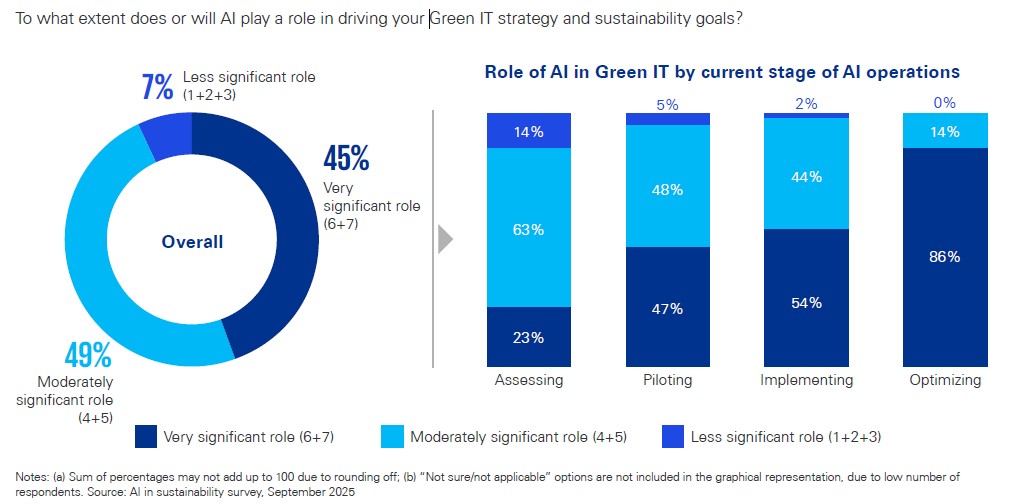
The sustainable development of artificial intelligence in enterprises mainly comes from two directions, namely external cooperation and internal support. In terms of external cooperation, over 90% of respondents listed environmental sustainability as a key criterion for selecting AI partners and hoped that suppliers would provide information on business efficiency optimization, sustainable energy procurement, water resource management, and demonstrate transparent and verifiable commitments to reducing environmental impacts. In terms of internal support, over 75% of respondents plan to increase green investments, optimize data center energy usage, expand cloud capabilities, and integrate renewable energy. 68% of respondents have set green investment targets, and the demand for sustainable infrastructure is continuously increasing.
Enterprises are taking measures to reduce the environmental footprint of artificial intelligence. 57% of enterprises have appointed sustainability department heads to lead the development of sustainable artificial intelligence, and 53% of enterprises have appointed both sustainability department heads and strategic department heads. In addition, collaboration between finance, procurement, and research and development departments also plays an important role. For example, the finance department guides funds towards carbon emission solutions, the procurement department chooses to collaborate with more sustainable cloud service providers, and the research and development department designs and develop lighter and more efficient models.
Sustainable Artificial Intelligence Challenges and Suggestions
Budget, data, and talent are the main challenges facing sustainable artificial intelligence. 57% of companies indicate that funding constraints limit their ability to incorporate sustainability into AI projects and are addressing this issue by adjusting investment priorities (63%) and phased investments (53%). In terms of data, 45% of enterprises mentioned data quality issues, and 43% of enterprises lack reliable methods to track AI energy usage. More than one-third of enterprises lack professional talents to carry out sustainable work.
In terms of investment return on sustainable artificial intelligence, 70% of enterprises have achieved a return on investment of 10% or lower. In addition to traditional financial investment return rates, sustainable artificial intelligence can also reduce business risks, reduce compliance costs, and improve brand resilience. These returns are often not measured, thus underestimating the overall investment return.
KPMG suggests that companies can develop sustainable artificial intelligence from the following perspectives:
- Incorporate sustainability into the roadmap for artificial intelligence development: Create long-term value by reducing waste and operational expenses and incorporate sustainability standards into cloud procurement and service level agreements.
- Use sustainability as a criterion for selecting technology partners: Suppliers are required to provide data on computational efficiency, renewable energy, water resource management, and Scope 3 carbon emissions.
- Establish cross departmental governance mechanisms: Bring together sustainable, strategic, financial, procurement, and business departments to set measurable energy, carbon emissions, and water resource targets.
- Develop key performance indicators related to artificial intelligence: Develop revenue and cost indicators related to artificial intelligence, incorporate the impact of artificial intelligence into sustainable disclosure and board reports, and seek third-party audits.
Reference: