
Report on Compliance Carbon Market Auction Mechanism
The CFA Institute Research & Policy Center releases a report on compliance carbon market auction mechanism, aiming to summarize the development and effectiveness of the auction mechanism.
The CFA Institute believes that global compliance carbon market quotas are transitioning from free allocation to auction mechanisms, and factors such as auction frequency, quota quantity, and auction price will have a key impact on the auction mechanism.
Related Post: CFA Institute Releases Global Compliance Carbon Market Report
Compliance Carbon Market Auction Mechanism Development
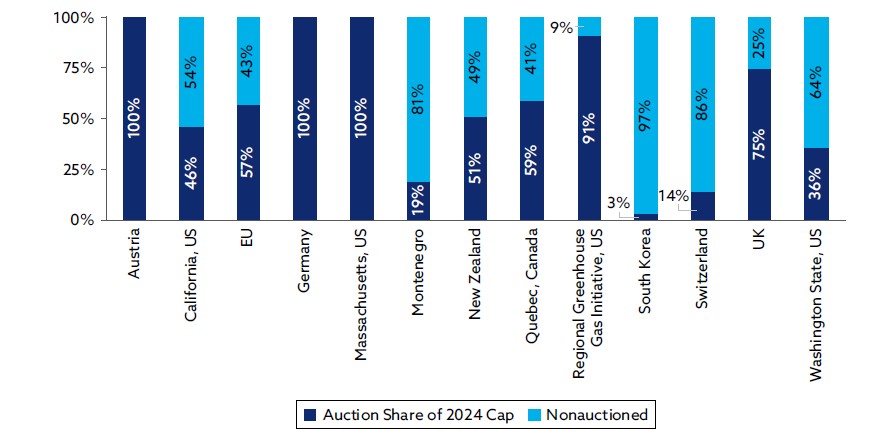
The auction mechanism is a manifestation of the sustained maturity of the compliance carbon market, and for investors, it can help them participate in the carbon market. For example, the EU Emissions Trading System auctioned off its 57% cap quota, and European asset management companies and banks purchased 45% of the EU carbon emission quota in the auction. These institutions can act as intermediaries for subsequent transactions or incorporate carbon quotas into trading strategies and investment portfolios. The importance of auction mechanism lies in:
- The auction determines the price and quantity of carbon quotas entering the market.
- Regulatory agencies can directly influence the supply and demand relationship by designing auction mechanisms.
- An effective auction mechanism can achieve efficient price discovery and generate stable price signals.
Introduction to Compliance Carbon Market Auction Mechanism
The CFA Institute analyzed the auction mechanisms of several major compliance carbon markets worldwide:
EU Emissions Trading System
The EU Emissions Trading System was established in 2005, relying almost entirely on free allocation in the first phase (2005-2007), and introducing an auction mechanism in the second phase (2008-2012) to sell 3% of the total quota. The third stage (from 2013 to 2020) saw auctions become the main allocation method, accounting for 57% of the total quota. Since 2010, auctions have been held at the European Energy Exchange, and by the end of 2024, over 2800 have been held.
The EU adopts a unified price, single round sealed bidding auction method, where participants submit, modify, and withdraw bids within two hours of the bid window opening, without being able to see other bids. After the bidding window is closed, the European Energy Exchange sorts the bids in descending order of price, and the price at which the cumulative bidding volume reaches the auction volume becomes the auction clearing price.
California Cap and Invest Program
The California Cap and Invest Program was established in 2012 and has been jointly holding quarterly auctions with the Quebec Cap and Trade System since 2014. Each year, two carbon markets calculate their annual auction reserve prices by adding 105% of the previous year’s reserve price to the inflation rate in their respective jurisdictions. The higher reserve price in the two carbon markets becomes the reserve price for the joint auction. For example, the reserve price for California in 2026 is $27.94, Quebec is $26.47 CAD ($19.35), and the reserve price for joint auctions is $27.94. The joint auction between California and Quebec also adopts a unified price, single round sealed bidding auction method.
Effect of Compliance Carbon Market Auction Mechanism
The CFA Institute believes that the effectiveness of compliance carbon market auctions depends on the following factors:
- Price stability: The market price differences in the EU Emissions Trading System are highly concentrated, with deviations mostly within 5%, thanks to the EU’s price stability mechanism. The time deviation between California Cap and Invest Program is generally small, but there are some extreme values due to the low auction frequency, and there may be a time gap between auction prices and transaction prices.
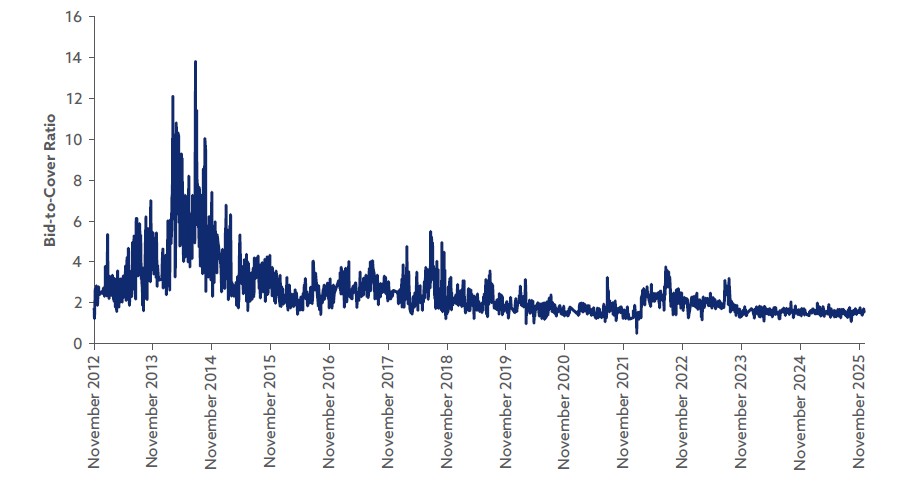
- Depth of demand: Depth of demand can be measured by the ratio of bidding volume to auction volume. The EU Emissions Trading System peaked at a depth of 14 in early demand but has gradually stabilized since 2015 and is currently maintained at around 2. The California Cap and Invest Program have fluctuated greatly due to significant changes in auction and bidding volumes, currently stabilizing at around 1.5.
- The constraint of reserve price: It can be measured by the difference between auction clearing price and reserve price. The difference indicates that auctions are mainly driven by the market, and the constraint of reserve price is high. The EU Emissions Trading System does not have a clear reserve price, and the premium of the California Cap and Invest Program gradually converges to zero starting from 2024.
The CFA Institute believes that the development of compliance carbon market auction mechanisms in the future needs to be focused on:
- Auction frequency: A higher auction frequency helps reduce the gap between clearing prices and market valuations, improve the convenience and accessibility of the auction market, and enhance market participation.
- Auction share: An increase in auction share represents a shift in the market from free allocation to auctions, attracting more parties to enter the market.
- Auction reserve price: In the early stages of carbon market development, reserve price can establish market expectations, but as the market matures, reserve price may limit liquidation price, leading to valuation deviation.
- Secondary market trading volume: An increase in secondary market trading volume indicates stronger liquidity in the carbon market, providing more price information and helping participants form more accurate price expectations.
Reference: