Sustainability Valuation Gap Report
KPMG releases Sustainability Valuation Gap Report, aimed at analyzing the valuation gap between a company’s perception of sustainable development and its financial decisions.
This report surveyed over 2000 senior executives in 19 countries worldwide, and only 19% of companies use quantitative methods to translate sustainable development impacts into financial indicators.
Related Post: KPMG Releases Sustainable Artificial Intelligence Report
Analysis of Sustainability Valuation Gap
KPMG believes that there is a gap between senior management’s understanding of sustainable development risks and opportunities and their ability to apply this understanding to financial decision-making. The data shows that for senior management:
- 72% have a clear understanding of the company’s sustainable development strategy, indicators, and performance.
- 60% consider sustainable development risks and opportunities in financial planning.
- 50% indicate that sustainable development is an important component of corporate strategy.
- 40% incorporate sustainable development into innovation and product development.
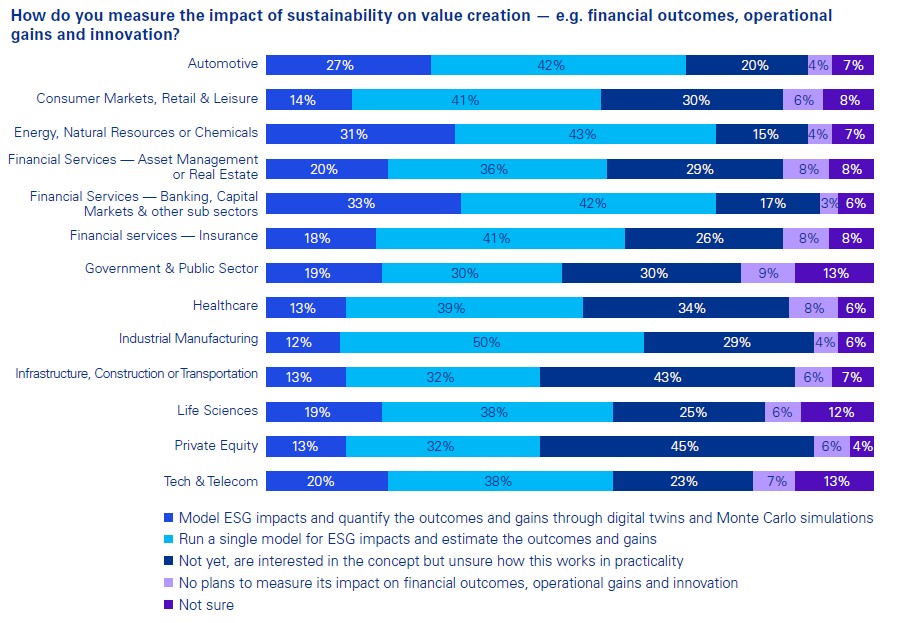
- 19% quantify the impact of sustainable development on financial results, operating income, and innovation.
Regulation plays a key role in enhancing corporate awareness of sustainable development. For example, the European Green Deal requires achieving carbon neutrality by 2050, and regulatory policies are formulated in multiple areas such as due diligence, carbon markets, taxation, and sustainable information disclosure. Data shows that European companies have a higher awareness of sustainable development than other regions. From an industry perspective, the sustainable valuation gap in the banking (33%), energy (31%), and automotive (27%) industries is relatively small, possibly because their financial data is more susceptible to the impact of sustainable development risks. For example, banks have indicators such as capital adequacy ratio and credit risk in sustainable risk management, as well as methods such as scenario analysis and stress testing.
The report believes that sustainable development of enterprises requires three elements: scientific foundation, goals, and financial business cases. The scientific foundation and goals have significantly improved in recent decades, and businesses have a very sufficient understanding of climate and nature. However, in terms of financial business cases, companies’ financial methods and valuation tools are relatively lagging, and sustainable development is often treated as compliance work rather than on the same level as capital allocation, strategic risk, and investment evaluation.
How to Narrow Sustainability Valuation Gap
To narrow the gap in sustainable valuation, sustainable development needs to prove its value in terms of competition, resilience, and returns. KPMG is collaborating with the World Business Council for Sustainable Development to develop sustainable valuation tools that quantify the financial impact of sustainability related risks and opportunities. The cooperation will first focus on the physical risks of climate change, and the planned issues to be addressed include:
- Method: Enterprises lack a consistent approach to transforming sustainable opportunities into value.
- Integration: Sustainable development risks and opportunities need to be incorporated into daily operations and strategic activities.
- Governance: Most companies lack the governance structures, capabilities, and systems needed to incorporate sustainable development into the financial decisions of their board of directors and senior management.
Reference: