Global Blue Finance Instruments Report
The World Bank releases Global Blue Finance Instruments Report, which aims to introduce and summarize the development of global blue financial instruments and provide recommendations.
The World Bank believes that blue finance can protect and restore oceans, support ocean conservation, sustainable fisheries, marine infrastructure, and nature related solutions.
Related Post: World Economic Forum Releases Regenerative Blue Economy Report
Introduction to Blue Finance Instruments
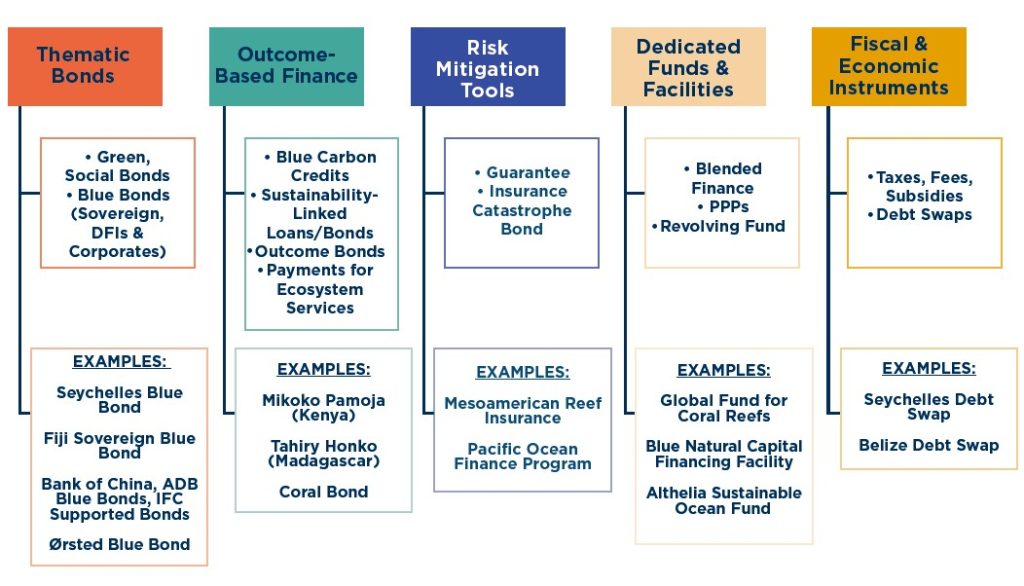
The World Bank believes that global blue finance instruments can be divided into five categories, namely:
Theme Bonds
Blue bonds are a category of themed bonds specifically designed to provide funding for sustainable ocean activities, with revenue from blue bonds directly used for ocean conservation and sustainable fisheries. Blue bonds can be divided into sovereign blue bonds, open bank blue bonds, and corporate blue bonds. In 2018, Seychelles issued the world’s first sovereign blue bond, which was supported by technical assistance from the World Bank and combined with Debt for Nature Swaps, demonstrating the sustainable performance of blended financing.
Result Oriented Financing
Result oriented financing links funds to clear environmental or social outcomes, including blue carbon credits, biodiversity credits, etc. This mechanism can motivate stakeholders to achieve specific goals. The mangrove project is a typical blue carbon credit project that provides funding for mangrove conservation and local development through strict carbon accounting and carbon credit sales.
Risk Management Tools
Risk management tools aim to protect the blue economy from environmental shocks, climate risks, and natural disasters. For example, parameter insurance is triggered based on special environmental conditions rather than calculating actual damage. This tool can ensure that affected individuals and businesses can quickly recover after extreme weather events occur.
Fiscal and Economic Tools
Natural debt swaps are financial mechanisms that link sovereign debt transactions with environmental outcomes. By restructuring or repurchasing a portion of sovereign debt, the saved financial resources are invested in environmental protection and ecological restoration projects. The trading party usually repurchases sovereign debt at a discounted price, and the debtor promises to use part or all the saved funds for environmental protection projects, such as the construction of marine protected areas, sustainable fisheries management, coral reef ecological restoration, etc.
Special Funds and Mechanisms
Specialized funds and mechanisms provide long-term sustainable financing solutions by integrating public and private funds. Revolving funds are mechanisms that ensure funds are reinvested in sustainable projects, typically providing credit guarantees or result based financing to use repaid funds for new projects. Public Private Partnership is used for financing, developing, and operating sustainable marine projects. Blended Finance Structures typically combine the two mechanisms mentioned above to reduce investment risk and attract funds.
How to Promote Blue Finance Instruments Development
The World Bank believes that the following measures can promote blue finance instruments development:
- Establish a clear, stable, and investor friendly policy and regulatory environment to promote sustainable use of marine resources and provide incentives to attract investors to participate. Simplify the investment review process, define blue economic activity standards, and reduce uncertainty.
- Build a robust system of data, indicators, and methods to assist investment decision-making, risk assessment, and performance monitoring, and track the environmental, social, and economic benefits of blue finance.
- Incorporate blue finance into priority strategic priorities, aligning it with broad sustainable development and climate goals, and incorporate blue economy goals into Nationally Determined Contributions (NDCs) and sustainable finance classifications.
- Strengthen stakeholder coordination, promote continuous communication among communities, investors, and scientific structures, and facilitate the local implementation of blue financial instruments.
Reference:
Accelerating Blue Finance: Instruments, Case Studies, and Pathways to Scale