
2025 H2 Sustainable Fund Report
The Morgan Stanley Institute for Sustainable Investing releases 2025 H2 sustainable fund report, aiming to summarize the development trends of sustainable funds.
As of December 2025, the global sustainable fund AUM has reached a historical high of 4.13 trillion US dollars, an increase of 4% compared to June 2025. The proportion of sustainable funds in the total assets of global funds has decreased from 6.8% in June to 6.5%.
Related Post: Morgan Stanley Releases 2025 H1 Global Sustainable Fund Report
Sustainable Fund Market Development
The total size of global sustainable funds in 2025 increases by 16.3% compared to 2024, but the proportion of sustainable funds in the global fund industry continues to decline from 2023 onwards. The main reason for the decline is that the asset size of traditional funds has grown rapidly. Currently, 88% of sustainable funds are registered in Europe, while only 9% and 3% are in the Americas and Asia. Therefore, the various characteristics of the global sustainable fund market are closely related to the development of European sustainable funds. The development of the European sustainable fund benefits from regulatory policies such as Sustainable Finance Disclosure Regulation (SFDR).
In the second half of 2025, the global sustainable fund market has a net outflow of $86.4 billion, offsetting the net inflow of $23.6 billion in the first half of the year, resulting in a net outflow of $62.8 billion for global sustainable funds. This is also the first time that sustainable funds have experienced a net outflow of funds throughout the year. In contrast, traditional funds records net inflows in every quarter of 2025. From a regional perspective, Europe experienced a net outflow of $76.4 billion in the second half of the year, while the Americas experienced outflows of $3.9 billion and $3.8 billion in the third and fourth quarters, respectively.
Sustainable Fund Investment Performance
The median return of sustainable funds in the first half of 2025 is 12.6%, higher than that of traditional funds (9.3%). The median return of sustainable funds in the second half of 2025 is 5.3%, lower than that of traditional funds (5.5%). The reason why the return of sustainable funds in the second half of the year is lower than that of traditional funds is that their allocation to the global market is higher, while the global market performance in the second half of the year is weaker.
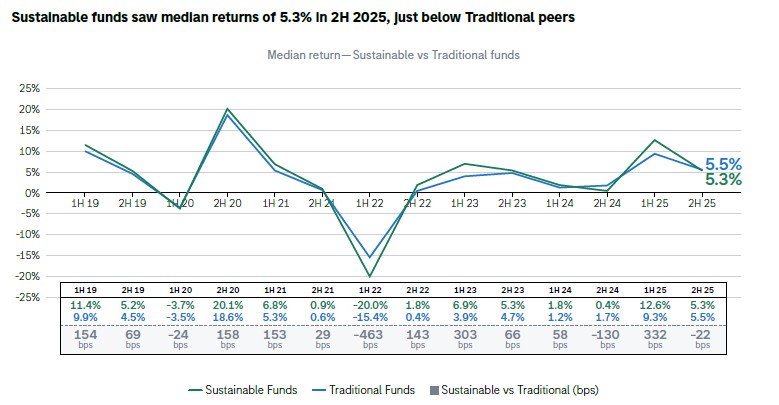
Despite the decline in returns, sustainable funds still have advantages in risk control. In the second half of 2025, nearly 90% of sustainable funds recorded positive returns, while 84% of traditional funds recorded positive returns. The downward deviation of stock based sustainable funds is 6%, while the downward deviation of traditional stock funds is 6.5%. Since the beginning of 2019, the total assets invested in sustainable funds have grown by 62%, while those invested in traditional funds have grown by 52%.
Private Sustainable Fund Development
This report is the first to include private sustainable funds in the study. From 2008 to 2025, the total size of private sustainable funds accounted for 6.8% of the private fund market, and by 2025, the market size of private sustainable funds had exceeded $1 trillion. Europe and North America account for over 80% of global fundraising. From the analysis of the number of private sustainable funds, venture capital funds account for the highest proportion, reaching 42.1%. From the perspective of asset size, physical assets (mainly infrastructure) account for the highest proportion of funds, exceeding 60%. The investment methods of private sustainable funds focus on impact investing, while public funds focus on ESG integration.
Reference: