
2026 Global Corporate Decarbonization Report
PwC releases the 2026 Global Corporate Decarbonization Report, aiming to summarize the progress of decarbonization in global corporates.
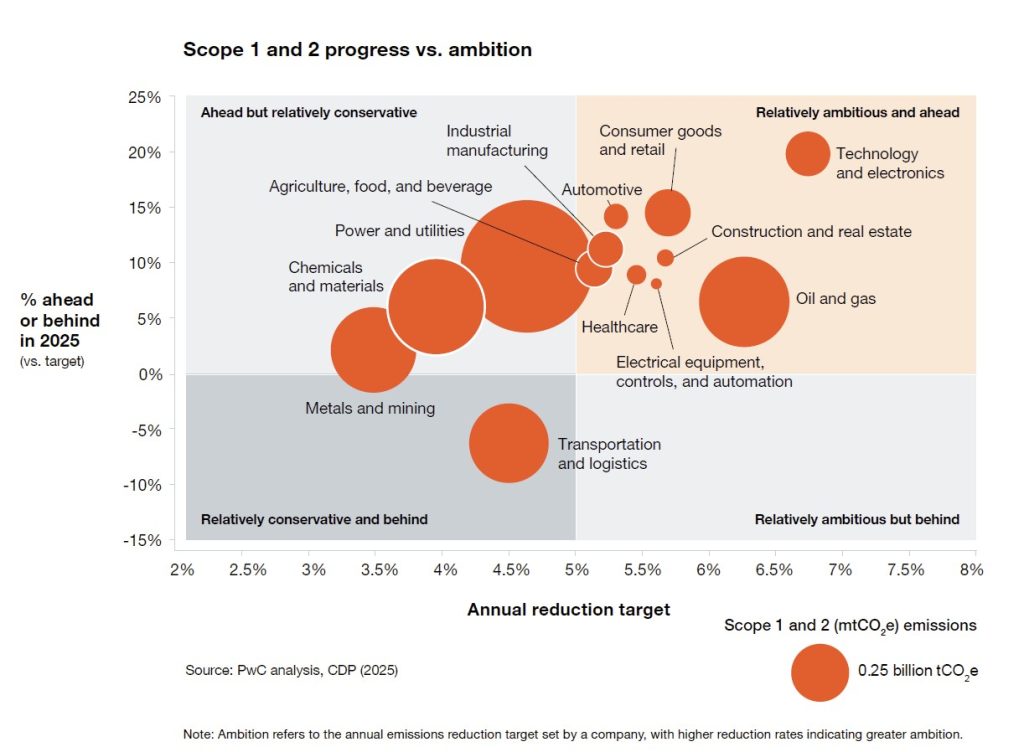
The report suggests that despite facing policy uncertainty, energy price fluctuations, and global tensions, companies have made significant progress in decarbonization. 82% of companies have maintained or accelerated their decarbonization schedule, and 69% of companies will achieve Scope 1 and Scope 2 goals.
Related Post: PwC Releases 2025 Decarbonization Report
Global Corporate Decarbonization Progress
In the past year, companies have faced complex external environments that have affected the way sustainable development is discussed but have not changed their actual actions. 7% of companies have set decarbonization targets for the first time, and more companies are adopting scientific carbon targets or externally validated decarbonization targets. This transition is mainly driven by the following factors:
- Customer pressure: Corporates are facing pressure from large customers who demand that they set goals, provide carbon emission data, and produce more sustainable products.
- Economic value: Decarbonization is generating value from three perspectives: cost, revenue, and risk. Corporates can optimize energy efficiency to reduce production costs, benefit from the growth of low-carbon market demand and reduce their climate risks.
- Regulatory requirements: Multiple jurisdictions around the world require companies to enhance their resilience to climate physical risks and climate transition risks, and decarbonization is an effective way to enhance climate resilience.
In terms of carbon emissions, companies have made positive progress in decarbonizing Scope 1 and Scope 2. In contrast, the decarbonization target for Scope 2 is easier to achieve because companies can purchase renewable energy to reduce carbon emissions. Scope 1emissions are directly related to the company’s own operations, and more detailed plans need to be developed. Currently, 46% of companies may achieve Scope 1 decarbonization targets.
The progress of decarbonization in Scope 3 is the most complex, as this type of emission accounts for most of the total emissions of corporates. However, it is difficult to achieve decarbonization goals by collaborating with suppliers, customers, and industry participants. Only 18% of companies can continuously track suppliers’ carbon emissions, and companies need to act in areas such as data quality and collaborative transition.
Corporate product design is becoming an important factor in decarbonization, and the design level can determine 80% of the environmental impact of products. At present, the proportion of corporates benefiting from the increase in sustainable product revenue has reached up to 25%. In the consumer industry, the profitability of corporates that consider sustainability in their design has increased by 8% to 13%. The report predicts that 33% of corporate revenue will be linked to climate transition by 2030.
The application of artificial intelligence in decarbonization is in its early stages, with 60% of corporates using AI in operational decarbonization. However, most of them are still at the machine learning level, with only 20% of corporates using more advanced AI technology and only 1% quantifying the carbon reduction effects brought by AI. The biggest challenge for the application of artificial intelligence is the lack of sustainable data, with only 14% of companies publicly disclosing the use of AI in decarbonization actions.
Reference: