2026 Global Warming Report
The United Nations Environment Program (UNEP) releases 2026 Global Warming Report, which aims to summarize current global warming trends and provide solutions.
The United Nations Environment Program believes that despite global efforts to address climate change, in the most optimistic scenario, the expected peak global warming will reach 1.8 degrees Celsius, exceeding the expectation of 1.5 degrees Celsius.
Related Post: What is Global Warming Potential GWP
Current Situation of Global Warming
The current global average temperature is 1.4 degrees Celsius higher than pre-industrial levels, and there is still room for 0.1 degrees Celsius of warming according to the target of 1.5 degrees Celsius. Based on the current rate of carbon emissions, global warming is expected to reach 1.5 degrees Celsius in 5 years. However, according to the sixth assessment report of the Intergovernmental Panel on Climate Change (IPCC), human and natural systems are already at extremely high risk at a warming level of 1.5 degrees Celsius. Even if the temperature rises below 1.5 degrees Celsius in the future, some ecosystems will undergo permanent changes. For example, the Antarctic ice sheet triggers an irreversible melting process after warming by more than 2 degrees Celsius, which can last for hundreds or even thousands of years.
The United Nations Environment Program uses a risk spiral model to analyze the complexity of global warming. During the warming phase, the hazards, exposure levels, and vulnerability reinforce each other, forming positive feedback. During the peak phase, the probability of triggering extreme events significantly increases. In the descending phase, for a given temperature, the risk after the descending phase is often higher than that during the warming phase, because there is a lag in the recovery of ecosystems and social systems.
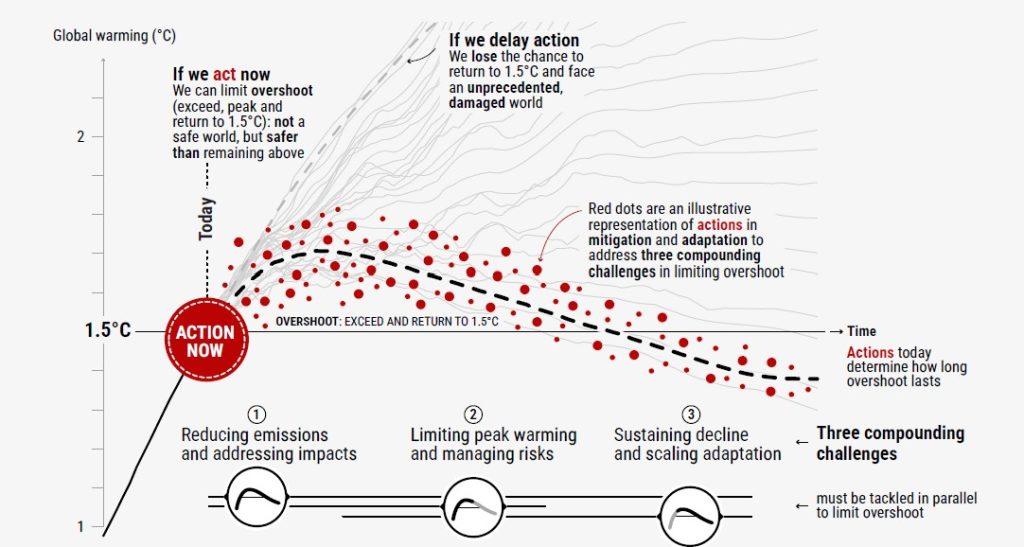
The current policies and investments are designed based on existing climate conditions and may face limitations in terms of functionality as the warming rate increases. Although the warming trend is inevitable, policies and investments in the next five to ten years will still affect the magnitude and duration of the warming, such as the deployment of clean energy, forest conservation, etc., which will determine whether net zero emissions can be achieved by 2050 and whether the peak warming will be 1.6 degrees Celsius or 1.8 degrees Celsius.
Risks and Impacts of Global Warming
The United Nations Environment Program believes that temperatures exceeding 1.5 degrees Celsius may accelerate sea level rise, damage coral reef ecosystems, and exacerbate extreme heat and wildfires. For example, by 2050, global food production may decrease by 14%, and by 2100, global glaciers may lose more than a quarter, causing sea levels to rise by 9 to 12.5 centimeters and permanently altering water supply in many regions. The incidence of extreme heat events has increased from once every 100 years in 2000 to once every 10 to 20 years.
To address the risks and impacts of warming, the world needs to achieve net zero emissions by the 1950s while reducing emissions of other greenhouse gases. The current global carbon emissions are 120% higher than the carbon emissions level of the 1.5-degree Celsius pathway in 2030. The report suggests that even if the scale of Carbon Dioxide Removal rapidly expands in the future, it will be difficult to achieve a temperature reversal. Therefore, it is more important to start reducing carbon emissions currently than to adopt emerging technologies for remediation in the future.
Reference:
Limiting Overshoot: Navigating Eceedance of 1.5°C and Pathways towards Return