Extreme Weather Risks Impact Report
The Carbon Disclosure Report (CDP) releases extreme weather risks impact report, aimed at summarizing the effects of extreme weather risks on businesses, cities, and financial systems.
CDP believes that extreme weather risks are transmitted through systems such as infrastructure, supply chains, and public services, causing approximately $2 trillion in economic losses to the global economy over the past decade.
Related Post: ECB Releases Climate and Nature Risk Management Practice Report
Awareness of Extreme Weather Risks
CDP data shows that 62% of 1005 cities worldwide have disclosed the impact of extreme weather events, with over 60% expecting an increase in both frequency and intensity of extreme weather risks, particularly extreme heat, floods, and droughts. These impacts will cause direct losses to the enterprise and indirect losses in all industries through chain effects. 23% of cities believe that the financial system will also be affected by climate disasters and have begun to view extreme weather events as financial risks.
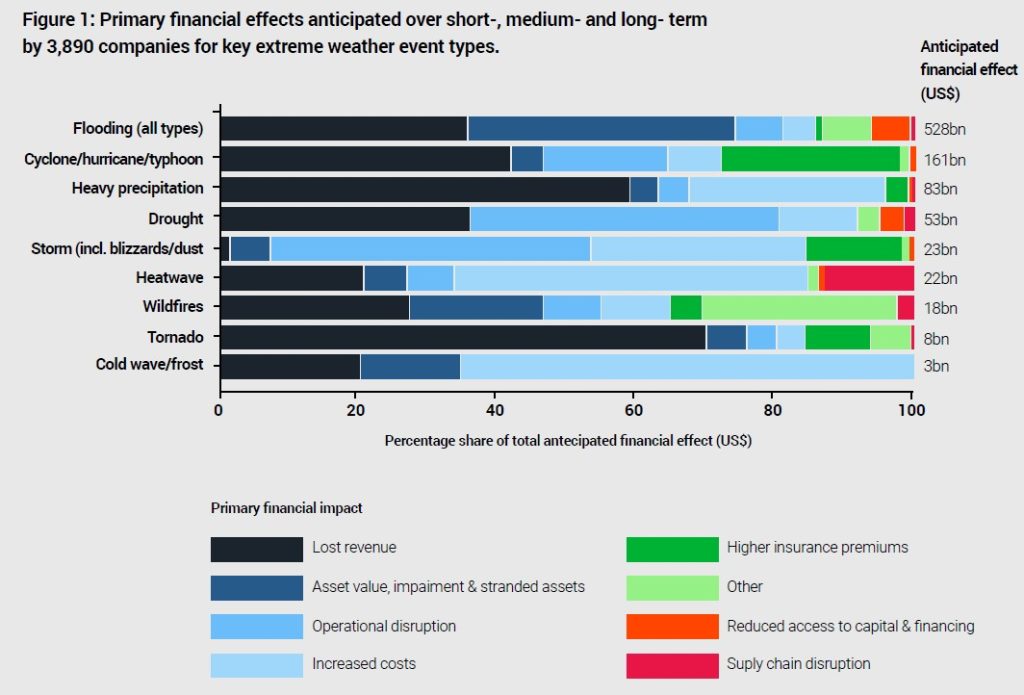
However, the awareness of extreme weather by enterprises is still lower than that of cities. Among 11261 enterprises, 3890 consider extreme weather risks as material financial risks, and the losses caused by extreme weather are about 900 billion US dollars. These losses are concentrated in a few extreme weather types, such as floods ($528 billion), cyclones ($161 billion), and heavy rainfall ($83 billion). From the nature of the losses, revenue losses ($326 billion) and asset impairment losses ($218 billion) account for a relatively high proportion, indicating that the expected risk exposure of the enterprise is not a single cost, but closely related to operating activities.
Insurance institutions are another major group affected by extreme weather events, with 48% of 149 considering extreme weather as a source of substantial financial risk, while only 2% of businesses believe that the impact of extreme weather risk comes from increased insurance premiums. This suggests that companies may not be aware that insurance conditions may tighten after extreme weather events occur. In terms of insurance premiums, companies believe that future insurance premiums will increase by $3.3 billion, while insurance institutions believe that future climate claims will reach $49 billion, indicating that cost growth, coverage limitations, and the possibility of insurance institutions exiting the local market are greater than expected by companies.
Suggestions for Managing Extreme Weather Risks
CDP believes that extreme weather risks will have a shared risk exposure for businesses, cities, and financial systems, therefore affected entities need to respond together. Enterprises need to be aware of the potential impact of risks on infrastructure and supply chain websites beyond revenue loss and asset impairment and consider changes in insurance availability and affordability in extreme situations. Enterprises can consider coordinating actions with stakeholders to reduce overall risk exposure.
For cities, increasing climate adaptation financing, providing preferential financing mechanisms and public investment frameworks can reduce the impact of climate physical risks on the economy. For regulatory agencies, when data from enterprises, cities, and financial systems reflect concentration risks in credit portfolios and underwriting assets, new requirements can be put forward for the capital adequacy ratio and risk management of these assets.
Reference:
Disconnected Defenses: Extreme Weather Risk Across Corporates, Cities and Financial Systems