
Nature-related Financial Risks Regulation Report
The Network for Greening the Financial System (NGFS) releases a report on nature-related financial risks regulation, aiming to summarize the regulatory framework for nature-related financial risks.
The NGFS believes that nature-related financial risks cover multiple areas such as climate change, biodiversity loss, and water scarcity, and their complexity and interconnectedness lead to regulatory oversight still in the early stages.
Related Post: Financial Stability Board Releases Report on Nature-related Financial Risks
Introduction to Nature-related Financial Risks
Nature-related financial risks refer to the negative impacts on financial institutions and the entire financial system caused by natural degradation, loss of biodiversity, and decline in ecosystem services (physical risks), or misalignment of nature conservation goals (transition risks). Compared to climate risk, natural risk is more complex and lacks consistent measurement indicators. The financial risks arising from nature-related financial risks are very significant. For example, a study by the European Central Bank (ECB) found that 75% of credit in the eurozone relies on at least one ecosystem service, and the International Monetary Fund (IMF) believes that nearly 40% of the world’s top 100 banks face natural transition risks in their operations.
Nature-related financial risks are endogenous, meaning that the business of financial institutions also exacerbates the natural risks they face. These risks are transmitted through traditional financial risk channels such as credit, market, and liquidity, and may affect financial stability. Therefore, they fall within the scope of regulatory agencies’ responsibilities. The NGFS divides the regulation of nature-related financial risks into three aspects:
- Risk identification: Analyze the dependence and impact of economic activities on nature, identify physical risks and transition risks.
- Economic risk assessment: Based on materiality principles, evaluate the economic impact of physical and transition risks on financial institutions.
- Financial risk assessment: Evaluate how economic risks can be transformed into traditional financial risks.
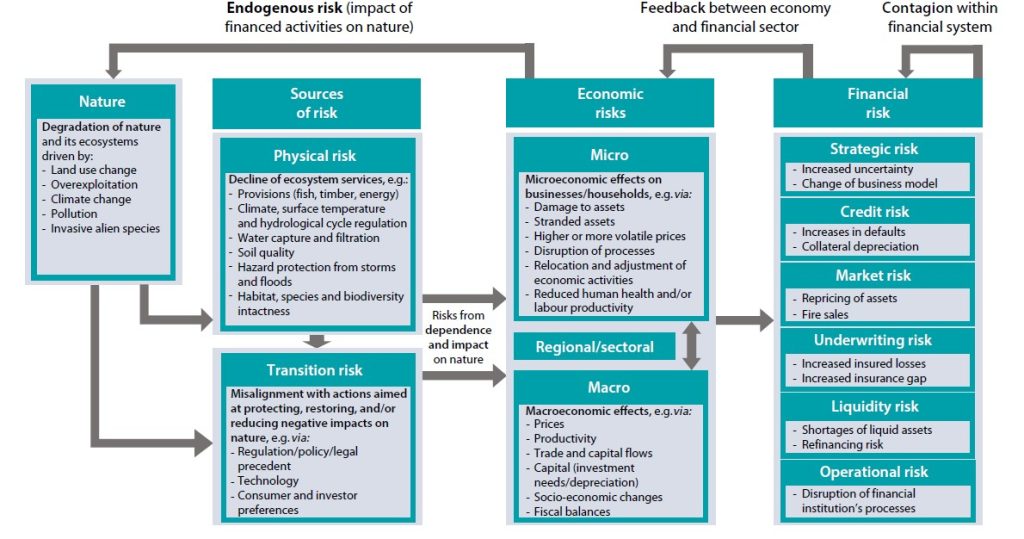
At present, regulatory agencies have started using various tools to assess nature-related financial risks:
- Physical risk identification: The Natural Capital Opportunity, Risk, and Disclosure Explorer (ENCORE) released by the United Nations Environment Program (UNEP) can assess the impact of economic activities on ecosystem services. For example, European regulatory agencies have found that 30% of insurance companies’ investment portfolios are highly dependent on at least one ecosystem service.
- Quantification of transition risk: Biodiversity footprint indicators (such as average species abundance) can be used to assess transition risk and are linked to the Global Biodiversity Framework (GBF).
- Scenario analysis and stress testing: Scenario analysis and stress testing can simulate the economic and financial impacts under different situations and are important tools for forward-looking evaluation.
Challenges in Nature-related Financial Risks Regulation
The NGFS believes that regulatory agencies face the following challenges in regulating financial risks related to nature:
- Data and methodology: Natural systems are highly complex and lack consistent measurement indicators. The quantity, quality, and evaluation methods of natural data have not been standardized, and regulatory agencies need to integrate multiple data sources and use proxy indicators to address this issue.
- Materiality assessment: Nature risk regulation not only needs to consider the exposure of financial institutions, but also their natural materiality. Some smaller financial institutions may be more susceptible to specific natural risks when their business models are concentrated, thus requiring stronger risk management.
- Connection between climate and nature: Climate risks and natural risks interact, and regulatory agencies need to adopt a comprehensive framework to simultaneously regulate both types of risks.
Reference: