2026 Global Emissions Trading System Report
The International Carbon Action Partnership (ICAP) releases 2026 global emissions trading system report, aiming to summarize the development of the global emissions trading system.
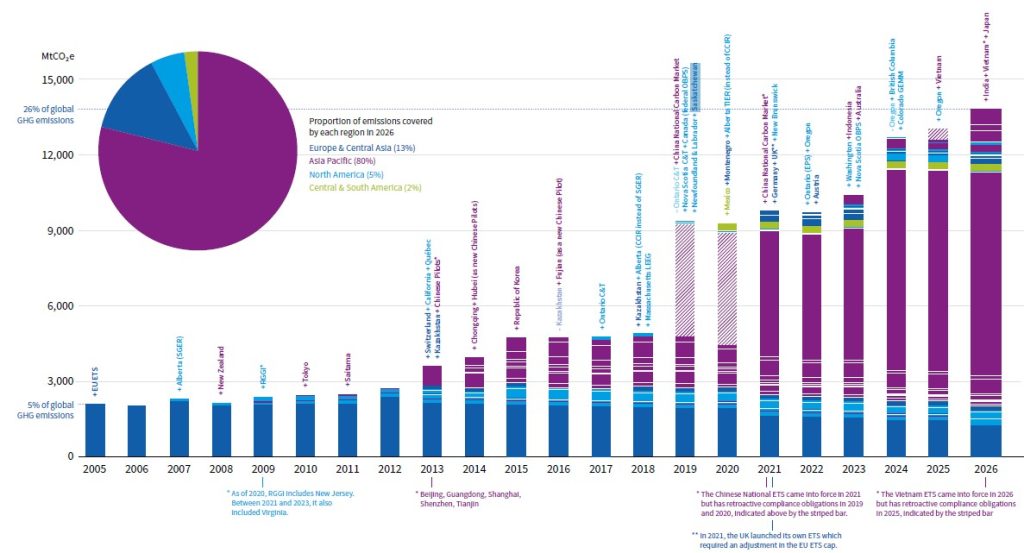
By 2026, there are a total of 41 carbon emission trading systems in operation worldwide, covering 26% of global greenhouse gas emissions, with a cumulative trading volume exceeding $454 billion.
Related Post: World Economic Forum Releases Report on Carbon Border Adjustment Mechanism
Introduction to Global Carbon Emissions Trading System
The global carbon emissions trading system mainly covers the power, industrial, and aviation industries, and gradually expands to include the construction and transportation industries. In terms of the threshold for enterprise inclusion, carbon emissions and energy consumption are the main indicators, which can be divided into monitoring threshold and compliance threshold. For example, the Brazilian carbon emissions trading system sets a monitoring and reporting obligation threshold for companies with annual carbon emissions exceeding 10000 tons of carbon dioxide, and a compliance obligation threshold for companies with annual carbon emissions exceeding 25000 tons of carbon dioxide.
In terms of quota allocation, the carbon emissions trading system is transitioning from a free allocation mechanism to an auction mechanism. The free allocation mechanism is still widely used in industries with high carbon leakage risks, such as the third phase of the EU Emissions Trading System, which adopts free allocation based on industry performance benchmarks and adjusts it through cross industry adjustment factors. The Canadian Emissions Trading System adopts the output benchmark method, which calculates free quotas based on the actual production and emissions of enterprises. The auction mechanism is gradually being mixed and applied in carbon emission trading systems due to its ability to collect funds and discover prices.
In terms of stability mechanisms, various jurisdictions have applied various price control tools and quota reserve mechanisms. The German carbon emissions trading system adopts a fixed carbon price (55 euros per ton in 2025) from 2021 to 2025 and transits to a price corridor mechanism in 2026. The Canadian Emissions Trading System sets the carbon price at CAD 95 per ton by 2025, with an annual increase of CAD 15. The United States sets up cost control reserves to provide additional quotas at fixed prices. The EU Emissions Trading System establishes market stability reserves, absorbs excess quotas, and maintains carbon price stability.
In terms of offsetting mechanisms, most carbon emission trading systems allow the use of carbon credit but impose strict restrictions. The South Korean carbon emissions trading system allows the use of domestic and international carbon credits but sets a quantity limit. Quebec, Canada allows the use of domestic carbon credits as well as carbon credits issued by California, USA. In terms of carbon credit projects, natural resources, renewable energy, and energy efficiency improvement projects are still the main types of projects, and some emerging technologies such as carbon capture technology have also begun to emerge.
In terms of interoperability, different carbon emission trading systems are collaborating to expand emission reduction capabilities and reduce compliance costs. Quebec, Canada and the California Emissions Trading System have been cooperating since 2014, forming the largest cross-border carbon market in North America and holding multiple carbon quota auctions in 2025. The EU Emissions Trading System plans to collaborate with the UK Emissions Trading System. However, this interoperability still faces challenges such as system design, legal framework, and disclosure standards.
In terms of revenue utilization, the carbon emissions trading system mainly invests revenue in the following areas:
- Climate Fund: Germany will inject revenue into the Climate and Transformation Fund to support industrial decarbonization and hydrogen economy.
- Fair transition: New York, USA distributes project benefits to some families.
- Technological innovation: The EU plans to use 300 million quotas to fund low-carbon energy projects.
Suggestions for the Development of Global Carbon Emissions Trading System
The International Carbon Action Partnership believes that the global carbon emissions trading system needs to focus on the following aspects in its future development:
- Capacity building: Emerging markets need to pay attention to the mechanism design, monitoring system, and market supervision of carbon emission trading systems.
- Standard compatibility: Jurisdictions need to strengthen coordination in areas such as carbon credit certification and carbon leakage.
- Fair transition: Prioritize supporting vulnerable groups in income utilization, balance climate goals and social equity.
- Environmental integrity: Strictly control carbon offset standards, prevent double counting of emission reductions, and enable the carbon market to truly play a role.
- Financial instruments: Introduce green bonds, transformational financing and other tools to encourage private capital to participate in the carbon market.
Reference: