
Financial Industry Climate Disclosure Report
The Organization for Economic Co-operation and Development (OECD) releases a report on financial industry climate disclosure, aimed at summarizing the greenhouse gas emissions and net zero disclosure situation in the financial sector.
The OECD believes that the financial industry needs to establish a climate disclosure framework to improve transparency, comparability, and credibility.
Related Post: Global Reporting Initiative Seeks Opinions on Financial Industry Standards
Background of Financial Industry Climate Disclosure
Disclosing greenhouse gas emissions, net zero targets, and related commitments in the financial industry can help regulatory agencies, investors, and other stakeholders understand their climate performance and risk management capabilities. Despite the existence of multiple voluntary disclosure frameworks globally, there is still room for improvement in clear and specific information disclosure. The climate disclosure issues in the financial industry include data gaps, methodological changes, etc.
The OECD believes that most voluntary disclosure frameworks have similar themes, but limited consistency in specific climate indicators, which may reduce the comparability of financial industry disclosures across different jurisdictions. With the global application of IFRS sustainable disclosure standards, these issues will gradually be resolved.
Financial Industry Climate Disclosure Analysis
The OECD analyzes the greenhouse gas emissions and net zero targets and commitments of the financial industry
Greenhouse Gas Emissions
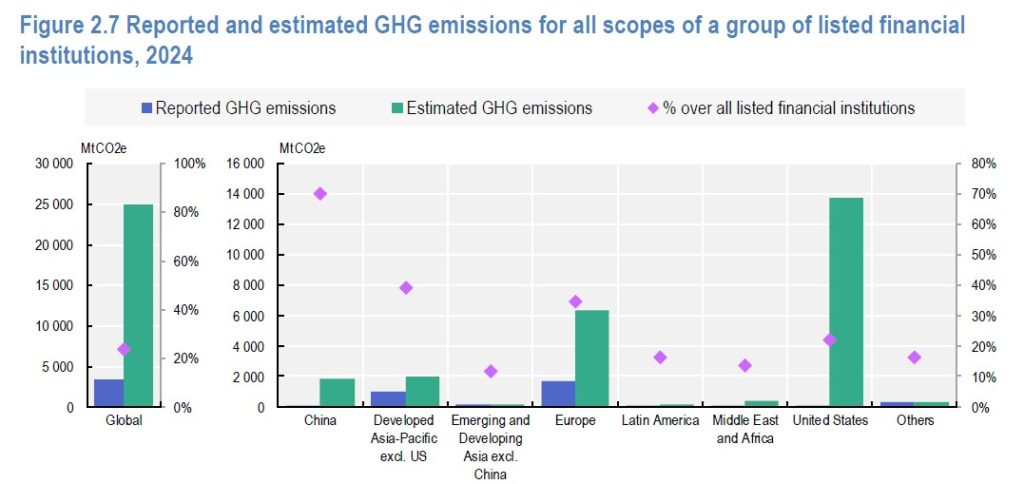
Due to industry characteristics, Scope 3 carbon emissions (especially Category 15 financing emissions) are the largest component of greenhouse gas disclosure in the financial industry. 19% of listed financial institutions worldwide disclose Scope 3 data, which is lower than the 23% of Scope 1 and Scope 2. After incorporating estimated data provided by third-party data service providers, the disclosure ratio of Scope 3 increases from 19% to 57%. Assuming accurate estimation data, the real carbon emissions of the financial industry may be eight times higher than they are now.
91% of Scope 3 data from financial institutions disclosing financing emissions comes from credit and investment activities. Half of the financial institutions have disclosed the methodology for greenhouse gas emission indicators, with the GHG Protocol being the most widely used. From regional analysis, large financial institutions in Europe (96%), the United States (87%), and the Asia Pacific region (85%) have a relatively high proportion of disclosures. Some key issues include data gaps in emerging markets and insufficient measurement methods for non-equity assets.
Net Zero Targets and Commitments
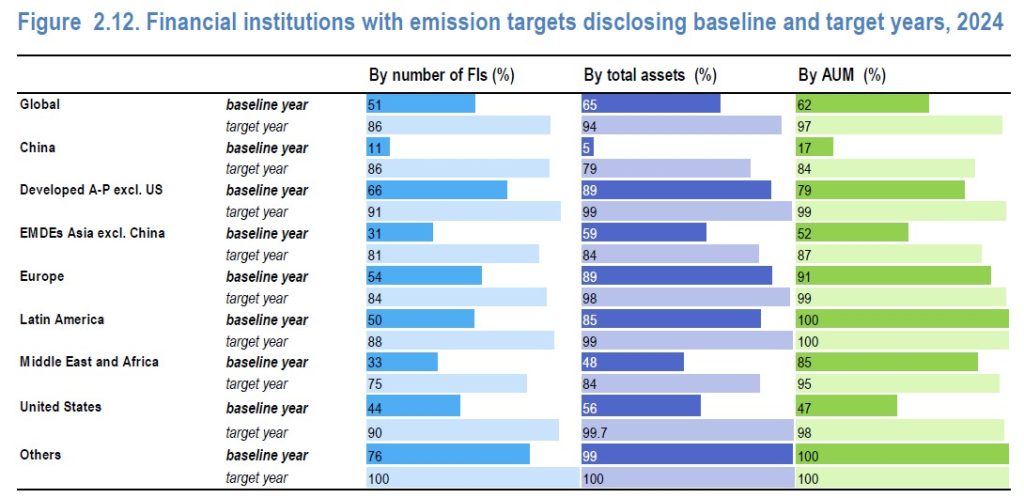
908 listed financial institutions worldwide have set emission reduction targets, accounting for 78% of the total assets of global financial institutions. However, only 27% of institutions included Scope 3 carbon emissions when setting targets, with 22% including Category 15 financing emission targets. In terms of detailed information, 51% of financial institutions disclose their target baseline year, 86% disclose their target year, and 26% disclose their baseline emissions. These missing pieces of information may affect investors’ assessment of net zero progress.
78% of financial institutions aim to achieve net zero, with 41% setting science-based emission reduction targets, but only 14% of institutions have joined the Science Based Target Initiative (SBTi). 87% of financial institutions identify climate related risks as material risks, and 85% disclose board oversight of climate risks. In addition to carbon emission targets, financial institutions have also begun to use investment portfolio composition, proportion of green income, and issuance of sustainable financial instruments as measures.
Suggestions for Financial Industry Climate Disclosure
Based on the above analysis, the OECD believes that the financial industry can improve climate disclosure in the following directions:
- Enhance data accessibility: Supply climate disclosure information (such as historical emissions, target information), apply internationally recognized climate disclosure frameworks, and create a digital taxonomy for climate disclosure.
- Improve disclosure quality: Introduce third-party audit requirements to reduce discrepancies between climate disclosure and estimates.
- Upgrade the effectiveness of emission reduction targets: Encourage financial institutions to develop net zero transition plans and provide regulatory incentives.
The OECD believes that financial institutions can establish a climate disclosure framework:
- Collect data: Ensure obtaining necessary climate information.
- Measure objective: Measure the comprehensiveness and feasibility of climate targets based on emission ranges.
- Join initiative: Consider actual performance and results while participating.
- Assess corporate governance: Review the board’s oversight of climate risks.
- Track climate financing: Consider the use of financial instruments such as green bonds and sustainable loans.
Reference: