
2025 Asian Utilities Engagement Program Progress Update
The Asia Investor Group on Climate Change (AIGCC) releases 2025 Asian Utilities Engagement Program report, aimed at summarizing investors’ impact on climate action in the Asian utilities industry.
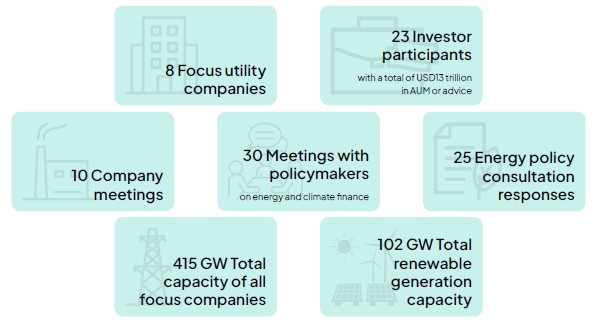
The Asian Utilities Engagement Program aims to reduce carbon emissions, strengthen climate related financial disclosure, and improve climate risk governance. The plan involves 23 investors with AUM exceeding $13 trillion.
Related Post: Asia Investor Group on Climate Change Releases Report on Utility Engagements
Asian Utilities Engagement Program Progress
The Asian Investor Climate Change Group evaluates the impact of investors in the utility industry from the following perspectives:
- Assessment framework and scope: In 2025, investors provided a more detailed assessment of the utility industry, drawing on the World Benchmark Alliance’s just transition approach and MSCI Institute’s climate resilience analysis to analyze corporate disclosure and transition maturity.
- Overall progress and strategic gap: Most companies have made progress in climate governance and transition planning, with boards of directors generally monitoring climate issues, increased disclosure of corporate transition plans, and funding accelerating investment in renewable energy and low-carbon technologies. Communication between investors and enterprises includes investment in power networks and transition finance.
- Climate governance: All companies have assigned climate responsibility to their boards of directors and implemented sustainable development strategies, and some companies have linked senior management compensation to climate performance. However, most corporate boards lack experts in the fields of climate change and low-carbon transition, which may limit the effectiveness of board climate governance.
- Decarbonization Strategy: Most companies have already developed transition plans and identified decarbonization levers. Most enterprises are in the early or mid-stage of decarbonization, with limited carbon emissions coverage in their supply and value chains. A few companies have provided more detailed greenhouse gas disclosures and signs of low-carbon business model transition.
- Physical climate risk: Most companies have disclosed physical climate risk assessments, with a few conducting comprehensive geographic location assessments. No companies have disclosed their investment or operating expenses related to climate adaptation.
- Just transition: This report evaluates just transition as a separate factor for the first time, and the performance of enterprises is relatively weak. Some companies have demonstrated stakeholder engagement, but no companies have provided measurable indicators of just transition. As the impact of climate change on businesses deepens, a just transition may have a greater impact on their development.
Recommendations for Asian Utilities Engagement Program
The Asian Investor Climate Change Group provides the following recommendations for Asian Utilities Engagement Program:
- Improve enterprise evaluation methods: Encourage investors to continue communicating with stakeholders based on this report in 2026 to ensure that evaluation methods reflect current best practices.
- Accelerate just transition communication: Include just transition as a separate project in the investor expectations statement and communicate with businesses and policy makers.
- Expand the scope of policy discussions: Explore cooperation with regulatory agencies in emerging market economies based on existing Asian jurisdictions.
- Strengthen investor capacity building: Training and enhancing investors’ abilities in climate governance, transition finance, physical risks, and other areas.
Reference:
Energy Companies Need to Do More on Capital Allocation and Emissions Reduction Strategy