2025 Global Green Skills Report
LinkedIn releases 2025 Global Green Skills Report, which aims to summarize the development of green skills in the global climate and energy transition.
LinkedIn recognizes 1200 skills mentioned by global talents as green skills, which are divided into twelve categories.
Related Post: LinkedIn Releases Global Green Talent Supply and Demand Report
Global Green Skills Development
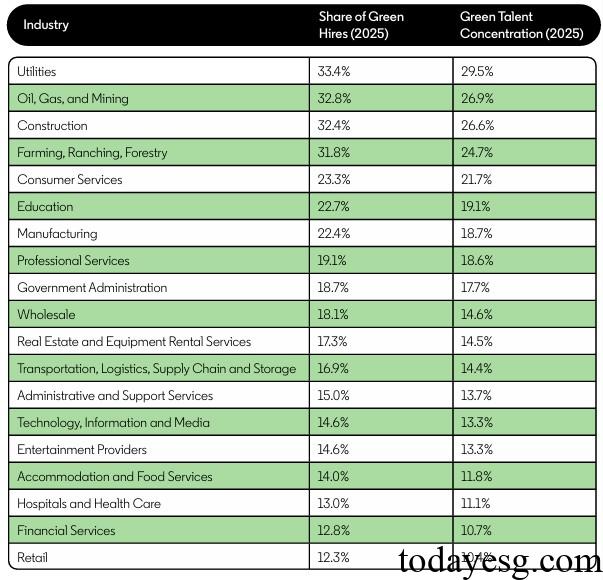
Since 2021, the global recruitment speed of green skilled talents has exceeded the training speed, and various industries are seeking to increase the reserve of green talents. From an industry perspective, the industries with a high proportion of global green talent recruitment in 2025 include utility (33.4%), fossil fuel industry (32.8%), and construction industry (32.4%). The industries with the fastest growth in the proportion of global green talent recruitment from 2021 to 2025 are the technology industry (11.3%), transportation industry (8%), and finance industry (7.5%).
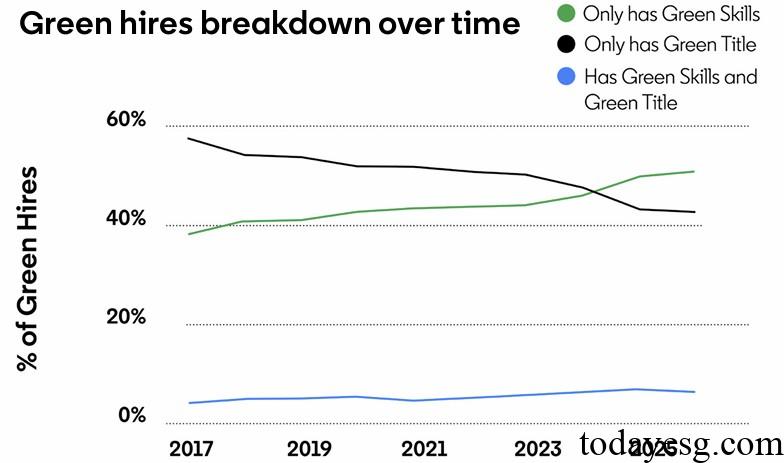
From the perspective of judicial jurisdiction, the proportion of green employment has increased in all regions from 2021 to 2025, and the growth rate of green recruitment is twice that of green skills. As companies gradually realize the value of green solutions to themselves, sustainability is becoming a driving force for business models and strategies. The new trend in the green employment industry in 2025 is that the demand for green skills in the market will exceed the demand for green jobs for the first time. This indicates that companies are realizing the importance of applying green skills in various fields, even if these positions may not be directly related to the company’s sustainable development.
For talents with green skills, LinkedIn data shows that their recruitment rate is 46.6% higher than the overall level, indicating that the market demand for green skills is continuously growing. Starting from 2022, the median success rate of job seekers with green skills has been increasing year by year. A survey conducted by LinkedIn in September 2025 showed that young people have a more positive attitude towards green jobs, with 50% of millennial expressing interest in pursuing green work and 60% of Generation Z.
The proportion of employees with at least one green skill has increased to 17.6% in 84 jurisdictions worldwide, up from 16.8% last year and 15.2% the year before. Global employee green skills have grown by 4.3% from 2024 to 2025, with a growth rate of 3.4% from 2021 to 2025. At the current growth rate, it is predicted that the growth rate of green skills will still not be able to achieve the goals of the Paris Agreement. In the next five years, global green jobs will grow by 260%, while green skilled employees will only grow by 60%.
How to Promote Green Skills Development
LinkedIn believes that in climate and energy transition, regulatory agencies and enterprises can take the following measures to promote the development of green skills:
- Making labor training a core component of climate and energy policies: Incorporating green skills into climate and energy policies to increase demand.
- Strengthening internal coordination among regulatory agencies: Climate, energy, and education departments can closely collaborate and jointly formulate policies.
- Updating education and training to adapt to the changing economy: Providing green skills training at different stages of education to adapt to market development.
- Tracking green employment and skills in labor market data: Statistical agencies can include green employment in regular talent reports.
- Strengthening cooperation: Enterprises, governments, and educational institutions can collaborate to address the shortage of green talents.
- Encouraging skill-based recruitment and talent development: Skill-based recruitment methods can expand the global supply of green talent by 3.5 times.
Reference: