Climate Finance Report for Developed Countries
The Organization for Economic Co-operation and Development (OECD) releases a report on climate finance in developed countries, aimed at summarizing the climate finance provided by developed countries.
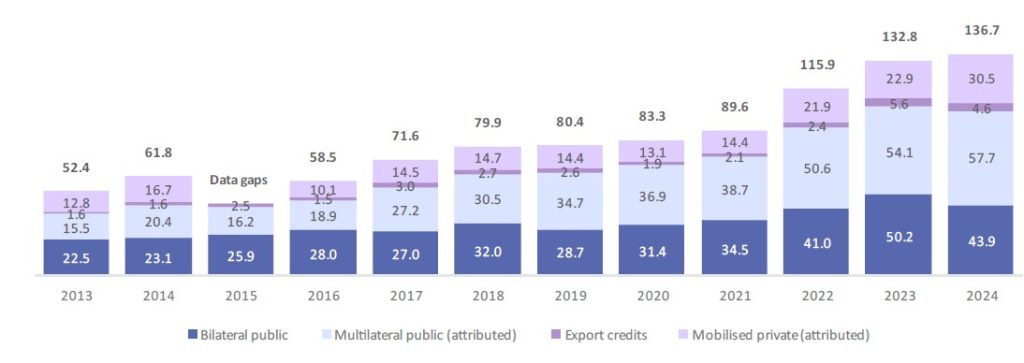
In 2023 and 2024, developed countries provided climate finance to developing countries of $132.8 billion and $136.7 billion, respectively, surpassing the target of $100 billion for the third consecutive year.
Related Post: Climate Policy Initiative Releases 2025 Public Development Bank Climate Action Report
Climate Finance Situation in Developed Countries
Public climate finance in developed countries is mainly provided in the form of credit ($75.6 billion in 2023, accounting for 73%, and $68.5 billion in 2024, accounting for 67%), followed by grants ($24.8 billion in 2023, accounting for 24%, and $29.7 billion in 2024, accounting for 29%). The scale of equity investment is relatively small ($3.7 billion in 2023, accounting for 4%, and $3.3 billion in 2024, accounting for 3%). Different climate finance providers choose different types of tools, with multilateral development banks primarily relying on credit and multilateral climate funds using grants more frequently.
Private sector funding is a key link in climate finance, growing to $22.9 billion in 2023 and $30.5 billion in 2024. Although the overall proportion is low, the growth rate is relatively fast. This growth mainly comes from multilateral development banks and multilateral climate funds. Most private sector funds are invested in middle-income countries (66%), with a few invested in low-income countries (3%).
In terms of climate finance investment, Asia received 39% of the total financing from 2016 to 2024, but its share decreased from 46% in 2016 to 36% in 2024. Africa received 29% of the total financing, with its share increasing from 24% in 2016 to 31% in 2024. The proportion of climate finance received by the Americas and Europe is 18% and 5%, respectively. From 2023 to 2024, low – and middle-income countries receive an average of 52.5 billion US dollars annually, a significant increase compared to 23.2 billion US dollars in 2026.
Classification of Climate Funds in Developed Countries
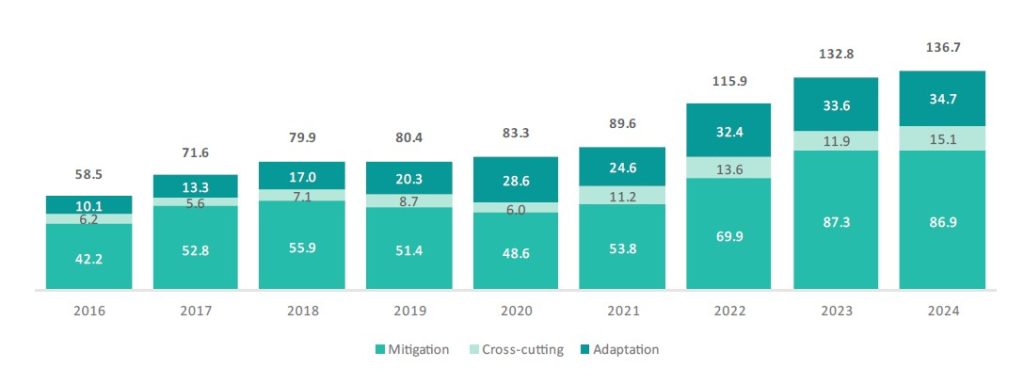
The climate adaptation funding provided by developed countries in 2023 and 2024 was 33.6 billion US dollars and 34.7 billion US dollars respectively, of which public climate finance was 30.6 billion US dollars and 31.7 billion US dollars, accounting for over 90%. From 2019 to 2024, the scale of private sector climate adaptation funding increased from $1.5 billion to $3 billion. The total amount of climate adaptation funding provided by developed countries increased from 17% in 2016 to a peak of 34% in 2020 and remained at 25% in 2023 and 2024.
The climate mitigation funding provided by developed countries in 2023 and 2024 was $87.3 billion and $86.9 billion, respectively. Cross sector funding (involving both climate mitigation and climate adaptation) increased from $11.9 billion in 2023 to $15.1 billion in 2024. The growth of climate mitigation funds reflects the sustained investment of developed countries in areas such as renewable energy, energy efficiency improvement, and low-carbon transportation, as well as the financing support provided by multilateral development banks and institutions for green energy projects. Climate mitigation funding is mainly in the form of credit, as these funds are often associated with large-scale infrastructure projects. At present, the total scale of climate mitigation funding still far exceeds that of climate adaptation funding and cross sector funding.
Reference:
Climate Finance Provided and Mobilised by Developed Countries in 2013-2024