2026 Green Economy Investment Report
The London Stock Exchange Group (LSEG) releases 2026 Green Economy Investment Report, which aims to summarize the global development of the green economy.
As of April 2026, the total size of the global green economy has exceeded $10 trillion for the first time.
Related Post: London Stock Exchange Group Releases 2025 Green Economy Investment Report
Global Green Economy Development
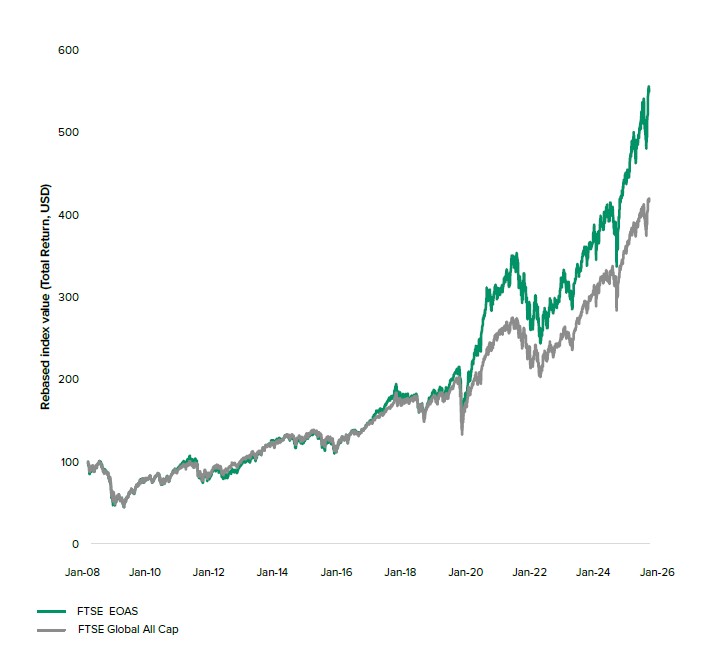
As of April 2026, the FTSE Environmental Opportunities All Share Index outperformed the market by 12.4% within 12 months, with the renewable energy and energy management industries performing well. If the green economy is set up as a separate industry, it has already become the third largest industry in the world, second only to the technology and industry industries. The green product and service revenue of 21000 listed companies worldwide increased by 5.3% in 2025, the fastest growth rate since 2022. Among 133 green products and services, 99 have seen revenue growth, with the electric vehicle manufacturing industry experiencing the largest growth, reaching $62 billion.
From the long-term performance of the green economy, since 2008, the global green economy has outperformed the market by 133%, with a compound annual growth rate of 18%, only lower than the technology industry (24%). Since 2023, the compound growth rate of the green economy has been 13%, which is twice the rate from 2020 to 2023.
Global Green Mergers and Acquisitions Development
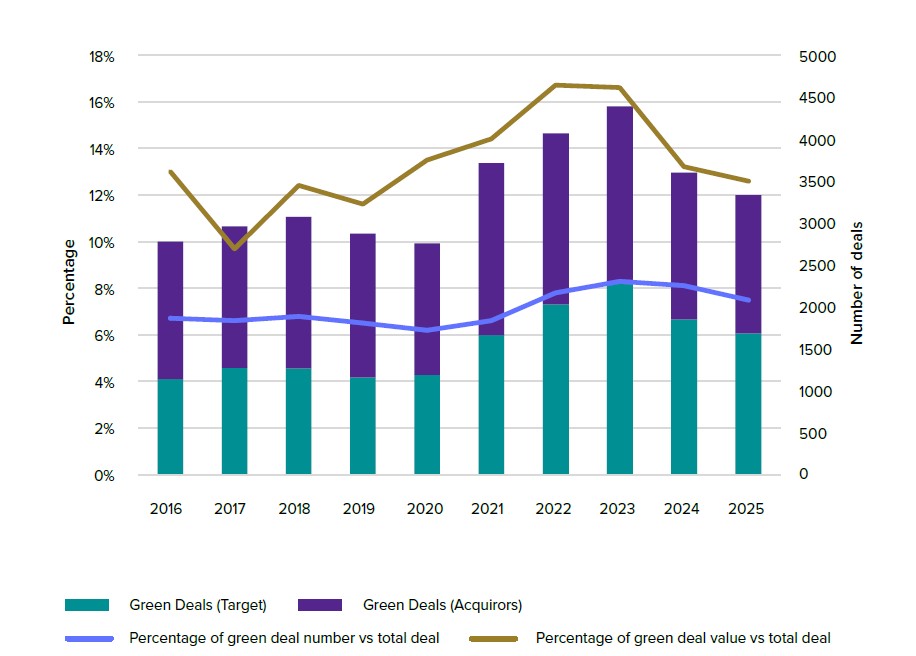
Green mergers and acquisitions are a core part of the global M&A market and an important transition mechanism for the development of the global green economy. The total scale of green M&A in 2025 is 308 billion US dollars, accounting for 12.6% of the global M&A. The total scale of green mergers and acquisitions in the past decade was 4.1 trillion US dollars, accounting for 13.4% of the global M&A. In 2021, green mergers and acquisitions reached a peak of $676 billion, but with rising interest rates and weakened financing conditions, the scale of mergers and acquisitions has continued to decline since 2022.
Green mergers and acquisitions are mainly driven by companies that have already generated green revenue, and these companies usually choose targets with a high proportion of green revenue. Only 4% of green mergers and acquisitions are initiated by non-green companies. Green mergers and acquisitions can help companies expand their green asset scale. The utility sector and green mergers and acquisitions are the most active, with a high proportion in the renewable energy generation sector. The green M&A scale in the four fields of energy management, energy generation, energy equipment, and transportation equipment accounts for 70% of the total.
Relationship between Green Income and Corporate Profitability
The London Stock Exchange Group analyzed the profit margins of over 4000 constituent stocks in the FTSE All World Index and found that companies with green revenue accounting for more than 50% have profit margins 2 to 4 percentage points higher than the industry median and are generally considered to perform well in green transition. In contrast, companies with relatively low green revenue typically have profit margins 2 to 3 percentage points lower than the industry median.
Green income and corporate profitability are also related to industries. In the real estate and public utilities sectors, companies with higher green income have profit margins higher than the industry median, indicating a correlation between green income and profit margins in these industries. In the energy sector, companies with higher green income have lower profit margins, possibly due to the high production capacity of these industries, the deep impact of subsidy policies, and the pricing pressure by fierce competition.
Reference:
Investing in the Green Economy 2026: Resilience and Reacceleration