
Blue Carbon Ecosystem Investment Guide
The World Economic Forum (WEF) releases a blue carbon ecosystem investment guide aimed at summarizing strategic paths for investing in blue carbon sink ecosystems.
The World Economic Forum believes that blue carbon ecosystems contribute approximately $190 billion annually to the global economy and have five times the carbon storage capacity of tropical rainforests, but they receive less than 1% of the total climate investment.
Related Post: European Investment Bank Releases Blue Economy Report
Background of Blue Carbon Ecosystem Investment
Blue carbon ecosystems are important climate solutions that can protect land from storms, support economic growth, and store carbon at extremely high densities. However, existing climate funding has not yet reached the scale required to protect and restore existing blue carbon ecosystems. In addition to public financing and preferential financing that can create investment conditions and reduce transaction risks, commercial financing is also the key to achieving investment in blue carbon ecosystems. These investments include the following methods:
- Direct investment: Deploying funds directly into measurable blue carbon projects or enterprises, such as project loans, equity investments, off take agreements, etc. This approach is closest to the underlying assets and has the greatest impact on the project or enterprise.
- Structured investment: Financial instruments that guide funds towards blue carbon ecosystems, such as themed bonds, hybrid financing facilities, etc. Financial institutions can transform small and diversified investment opportunities into products that institutional investors can access.
- Empowering investment: Taking market building actions to create favorable conditions for blue carbon investment, such as providing investment in data systems, supporting market infrastructure construction, etc.
Introduction to Blue Carbon Ecosystem Investment
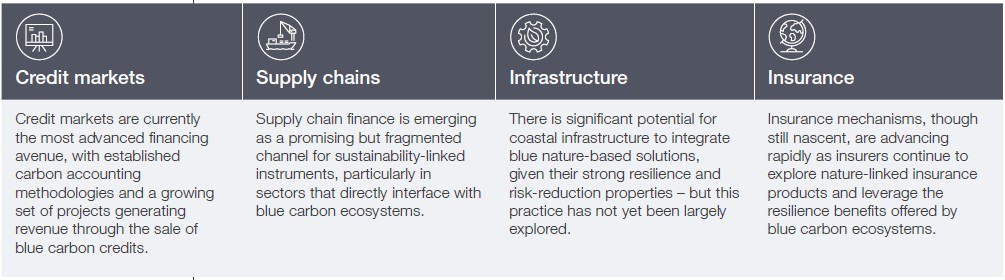
The World Economic Forum believes that there are several investment pathways for blue carbon ecosystems, including:
- Carbon credit market: Carbon credit market is the most mature and easily identifiable investment path, which forms tradable carbon credits by unitizing and monetizing carbon sinks. At present, the blue carbon credit market is relatively mature, but the initial capital expenditure is high, the income return cycle is generally over five years, and there is a lack of traditional investment collateral, which may affect investment.
- Supply chain: Integrate blue carbon ecosystems into coastal industries such as fisheries and aquaculture to improve production, reduce maintenance costs, and gain premiums. At present, this method is in its early stages, and some commercial pilot projects have demonstrated feasible models. However, for practitioners in small coastal industries, the short-term transformation cost is high, and industry certification is difficult to achieve.
- Infrastructure: Incorporate blue carbon ecosystems as natural infrastructure into development plans, reduce long-term maintenance costs, and bring synergistic benefits of carbon sequestration and biodiversity. Infrastructure investment can reduce the physical risks faced by assets, but there are significant differences between its engineering standards and regulations, operating expenditure patterns, and traditional infrastructure investment.
- Insurance: Insurance companies, reinsurance companies, and multilateral development banks can invest in the protection and restoration of blue carbon ecosystems, reducing the physical risk of their insured assets, thereby reducing claims and improving loss rates. This method can also be combined with the above three methods, but its challenge lies in the fact that the reduction of ecosystem risks is a public good and it is difficult to quantify the benefits generated by investment.
Reference: