
2026 Corporate Climate and Nature Progress Report
The Carbon Disclosure Project (CDP) releases 2026 Corporate Climate and Nature Progress Report, which aims to summarize the progress of companies in environmental areas such as climate and nature.
CDP believes that by 2035, the fixed losses caused by climate disasters for global listed companies could reach $560 billion to $610 billion annually, equivalent to a 6% to 7% decrease in profits. Enterprises need to take action to enhance the resilience of their business models.
Related Post: CDP Releases Report on 2025 Corporate Climate and Nature Progress
Background of 2026 Corporate Climate and Nature Progress Report
By 2025, over 22000 companies worldwide submit data through CDP, accounting for more than half of the total market value of global enterprises. CDP uses data from approximately 10400 companies, which have completed all of CDP’s questionnaires and received ratings based on evaluation criteria. This report evaluates how companies can improve their financial resilience while reducing their impact on the environment by analyzing these data. CDP has improved its evaluation methods based on last year, focusing on the following progress of enterprises:
- Governance.
- Dependencies, Impacts, Risks, and Opportunities.
- Target Setting.
- Strategic Planning.
Summary of 2026 Corporate Climate and Nature Progress Report
This report evaluates the progress of corporate climate and nature from three main themes:
- Climate change: greenhouse gas emissions (Scope 1, Scope 2, and Scope 3).
- Water resource security: enterprise water usage, water resource risk and opportunity management, and impact on the entire value chain.
- Forest: Risk management of deforestation in the supply chain of enterprises.
The report shows that addressing environmental impacts has a positive impact on the profitability of businesses, with higher-than-average market value growth in the clothing, biotechnology, and food industries. The report compared the group of companies with the best information disclosure and the group of companies with the worst information disclosure and found that this difference was most pronounced in the financial industry, clothing industry, and biotechnology industry. In the past 12 months, the group of companies with the best information disclosure has secured $218 billion in growth opportunities in the areas of climate, water security, and forests. These enterprises reduce their carbon emissions by an average of 4% per year, higher than other groups (1.5%, 1%, and 0.6%).
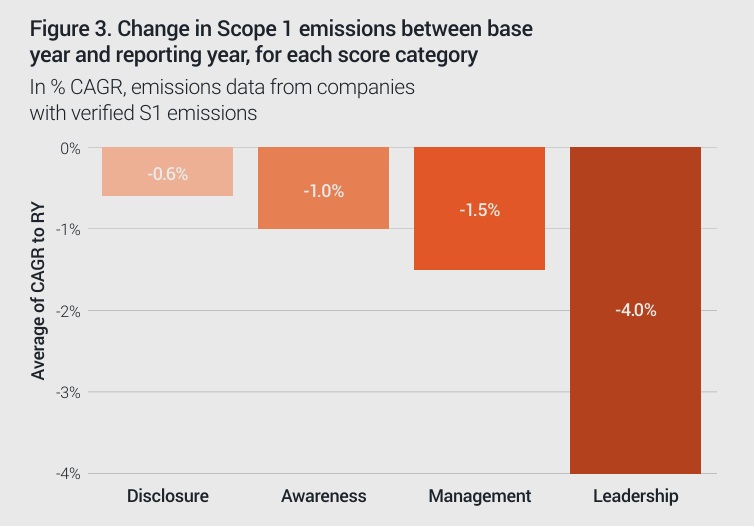
Despite the constantly changing market environment, 15% of enterprises are classified as the best group in at least one environmental theme, with climate accounting for 13%, water security accounting for 11%, and forests accounting for 8%, an increase of 5 percentage points, 4 percent points, and 3 percentage points respectively compared to last year. This indicates that companies are recognizing the importance of natural resources. The report suggests that the following factors help businesses make progress in the environmental field:
- Link executive compensation to environmental performance: 100%, 78%, and 78% of companies with the best information disclosure in the areas of climate, water resource security, and forests respectively adopt this measure to improve the consistency between management and corporate environmental goals.
- Develop sound environmental dependency, impact, risk, and opportunity management processes: 83%, 90%, and 93% of the companies with the best information disclosure in the fields of climate, water resource security, and forests respectively adopt this measure to help companies face long-term uncertainty.
- Propose a climate transition plan that meets the 1.5-degree Celsius warming target: Developing practical and feasible transition plans can help businesses adjust their business models and comply with the requirements of the Paris Agreement.
- Engage with the value chain: 97%, 98%, and 91% of the companies with the best information disclosure in the fields of climate, water resource security, and forests respectively have adopted this measure. Collaborating with companies in the value chain can reduce environmental impact.
Reference: