Nature Economy Investment Report
The World Economy Forum (WEF) releases nature economy investment report, aiming to summarize 50 investment opportunities in 13 industries related to the natural economy and provide a framework for financial institutions and enterprises to act.
By 2030, the global natural economy is expected to generate over $10.1 trillion in investment opportunities annually. However, the current global investment in natural solutions is only $220 billion per year, leaving ample room for commercial returns and ecological benefits.
Related Post: World Economic Forum Releases Nature Finance Report
Background of Nature Economy Investment
Natural economy refers to investments and activities that can reduce damage and pressure on nature. Its goal is to curb and reverse natural losses by 2030 based on 2020 and achieve comprehensive recovery by 2050. Nature economy investment faces various obstacles, such as investors’ insufficient understanding of the impact of nature, difficulties in pricing environmental externalities, and a lack of practical implementation of key performance indicators. The World Economic Forum believes that promoting nature investment requires correcting the following misconceptions:
Cognition 1: Nature economy investment is only applicable to impact investment and preferential financing
Nature investment can become a core component for companies to improve operations, increase revenue, and enhance resilience. The broad green economy accounts for nearly $8 trillion in the total market value of listed companies, and its performance has outperformed global stock indices by about 60% since 2008.
Cognition 2: Nature economy investment is only applicable to ecosystems rich in biodiversity
Nature investment mainly targets the five major factors that lead to nature loss:
- Climate change.
- Land and ocean changes.
- Overexploitation of natural resources.
- Pollution.
- Invasion of alien species.
Cognition 3: Nature investment mainly focuses on nature conservation and restoration activities
Nature investment is not limited to protecting and restoring biodiversity but also includes investments in reducing negative impacts of nature in the value chain, such as reducing pollution emissions, improving water resource efficiency, and sustainable procurement of raw materials.
Introduction to Nature Economy Investment
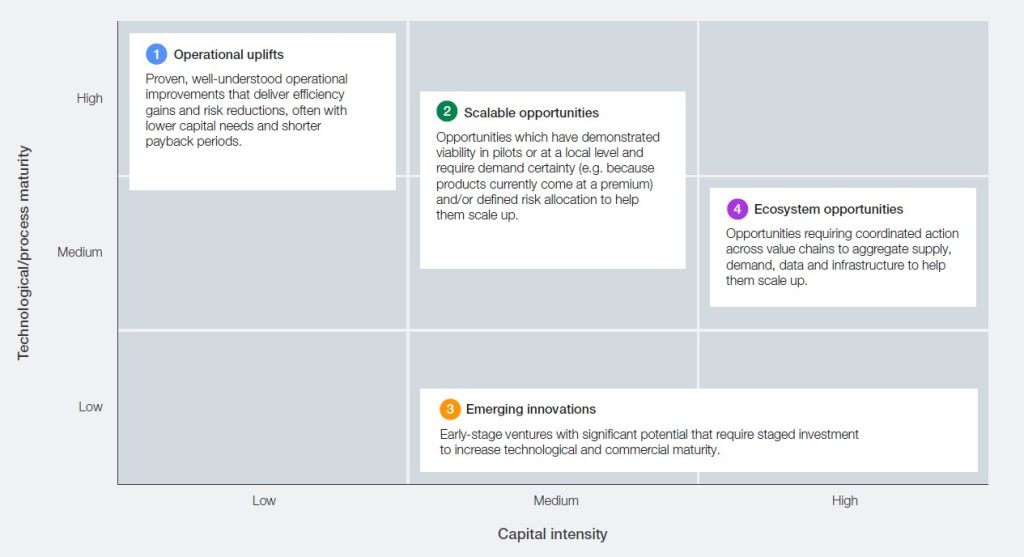
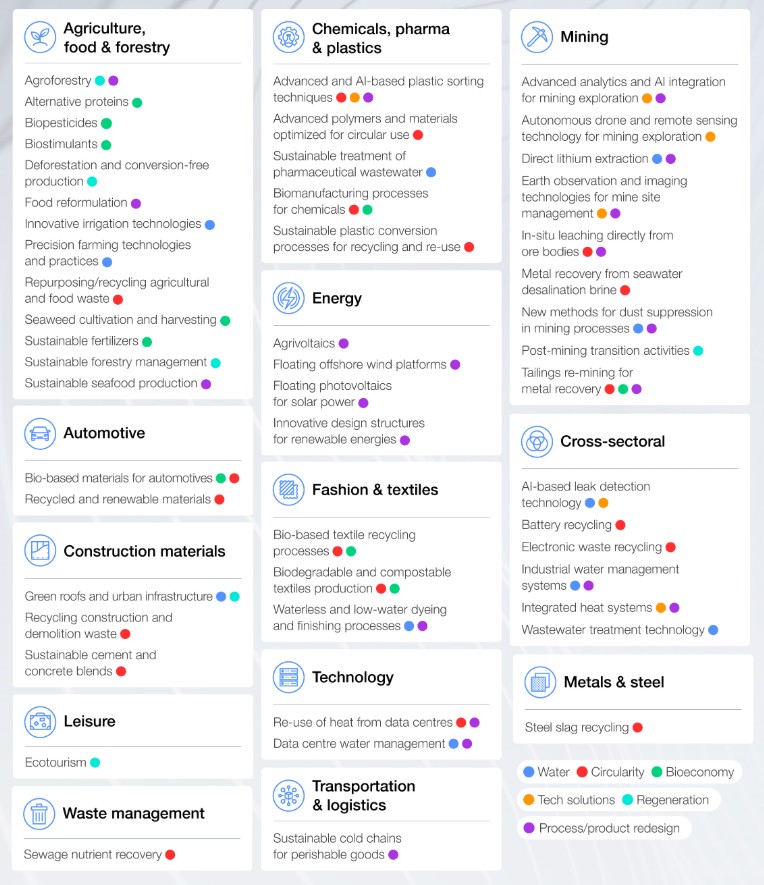
The World Economic Forum evaluates over 200 commercial activities in nature economy investment and selects 50 investment opportunities from 13 industries, covering biological solutions, technological solutions, waste utilization, and more. These investment opportunities can be classified into the following categories:
- Operational uplifts: high technological maturity and low funding requirements. These projects have been fully understood and can improve operational processes to enhance efficiency, with a shorter investment payback period. For example, industrial water management systems and sustainable irrigation technologies. These projects can be financed through sustainable credit.
- Scalable opportunities: The technology maturity is moderate, and feasibility has been verified in local markets, but more funding or clear risk sharing mechanisms are needed to help it expand its scale. For example, precision agriculture and ecotourism. These projects require mixed financing to increase risk mitigation mechanisms to attract funding.
- Emerging innovations: Low technological maturity with significant transition potential, requiring continuous investment to transition from concept validation to commercialization. For example, replacing protein and seaweed farming. These projects are suitable for private equity investment and venture capital.
- Ecosystem opportunities: The technology maturity is average, but the funding requirements are high, requiring coordination of supply, demand, data, and infrastructure investments. For example, battery recycling ecosystems and sustainable product supply chains. These projects require multi-party cooperation and continuous promotion through pilot projects.
To promote the application of nature economy investment opportunities, the World Economic Forum has proposed some priority actions for financial institutions, such as incorporating natural related risks and opportunities into strategic frameworks, developing more effective pricing, structural design, and monitoring measures for natural projects, and promoting innovative financing methods with risk mitigation mechanisms.
Reference: