
Carbon Removal Report
The World Economic Forum (WEF) releases a carbon removal report aimed at summarizing the deployment, market development, and prospects of carbon removal technologies.
The World Economic Forum believes that carbon removal has become a pillar for achieving the goals of the Paris Agreement, but still faces key challenges such as high costs, regulatory uncertainty, and insufficient demand signals.
Related Post: Carbon Dioxide Removal Definition, Classification, and Application
Carbon Removal Definition and Market
Carbon removal refers to the process and technology of actively extracting carbon dioxide from the air and storing it in natural or artificial storage warehouses, aimed at addressing historical and residual emissions. The International Energy Agency (IEA) believes that large-scale deployment of carbon removal is crucial to control global warming at 2 degrees Celsius.
However, the scaling up process of carbon removal faces multiple bottlenecks. Firstly, regulatory uncertainty suppresses corporate demand, and the Science Based Target Initiative (SBTi) ability to offset Scope 3 carbon emissions with carbon credits generated from carbon removal is not yet clear, resulting in limited willingness for companies to purchase. Secondly, some carbon removal technologies have higher costs than traditional carbon reduction measures. In addition, the different standards between voluntary carbon markets and compliant carbon markets can also weaken the liquidity of carbon credits.
Introduction and Comparison of Carbon Removal Technologies
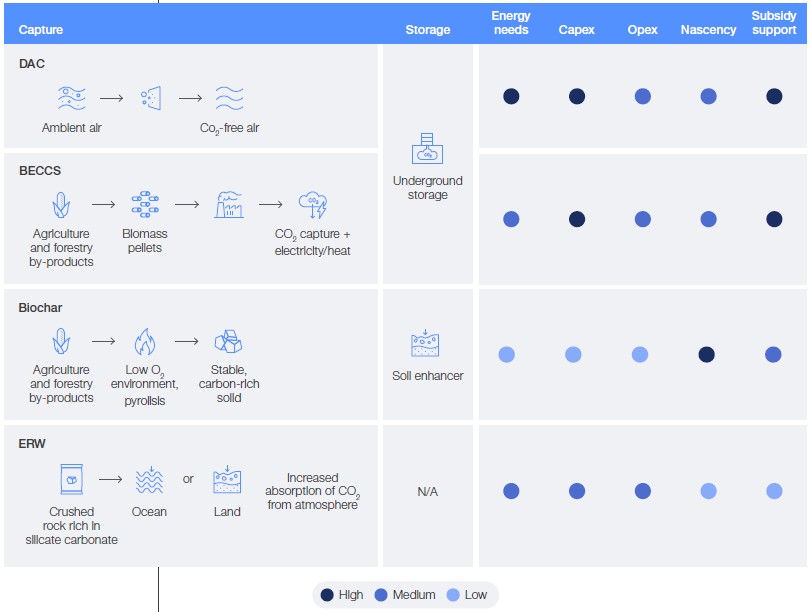
The current mainstream carbon removal technologies worldwide can be divided into engineering, natural, and hybrid solutions, with different technical principles, maturity, resource requirements, and risk characteristics:
- Direct Air Capture: Using chemical solvents or adsorbents to directly capture carbon dioxide from the air, followed by geological storage. Its advantages lie in high durability and mature technology, but its disadvantage is extremely high energy consumption and capital expenditure, heavily relying on renewable energy and carbon dioxide transportation and storage infrastructure. The current cost is approximately $500 to $1200 per ton.
- Bioenergy with Carbon Capture and Storage: Utilizing biomass to generate electricity or heat and geologically sequestering the released carbon dioxide. Due to the absorption of carbon dioxide by biomass, negative emissions can be achieved. This technology is highly efficient and can be integrated with existing energy facilities, but it faces challenges such as sustainable biomass supply and land use. The current cost is approximately $200 to $600 per ton.
- Biochar: Carbon rich solids are produced by pyrolysis of biomass in low oxygen environments, which can be used in soil to sequester carbon for hundreds of years and improve soil properties. Its technology is the most mature and deployed the fastest, but its carbon sequestration effect is affected by soil conditions and limited by biomass raw materials. The current cost is about $200 per ton.
- Enhanced Rock Weathering: Crushing silicate rocks and placing them on land or coasts to accelerate their natural chemical reaction with carbon dioxide to form carbonates. It has great theoretical potential and low energy consumption, but it is difficult to accurately quantify the carbon removal effect in open systems. The current cost is approximately $200 to $500 per ton.
The deployment of different carbon removal technologies varies greatly, with biochar being the most mature pathway and delivering the largest scale of carbon removal. The number of direct air capture projects is the highest, but most are in the pilot or demonstration stage. It is expected that the capacity of various paths will significantly increase by 2028, but obstacles such as financing and supply chain need to be addressed.
How to Promote Carbon Removal Market Development
The World Economic Forum believes that the following measures can promote the development of the carbon removal market:
- Promote standardization actions: Develop consistent contract frameworks and core terms, improve interoperability between different projects, and reduce transaction costs.
- Support financing for medium-sized projects: The scale of medium-sized projects exceeds the scope of early venture capital but has not yet reached the threshold for large-scale financing. Participants can package multiple medium-sized projects into asset portfolios to attract institutional investors.
- Strengthen policy signals: Regulatory agencies provide long-term and stable policy support, and establish clear rules related to carbon removal and Scope 3.
Reference:
Carbon Dioxide Removal Technologies: Market Overview and Offtake