Blue Food Report
The World Economic Forum (WEF) releases Blue Food Report, which aims to summarize the opportunities and challenges of the blue food industry and provide recommendations for promoting industry growth.
The World Economic Forum believes that with appropriate technological, policy, and investment support, blue food can meet global food demand, create economic value, and enhance ecological resilience.
Related Post: European Investment Bank Releases Blue Economy Report
What is Blue Food
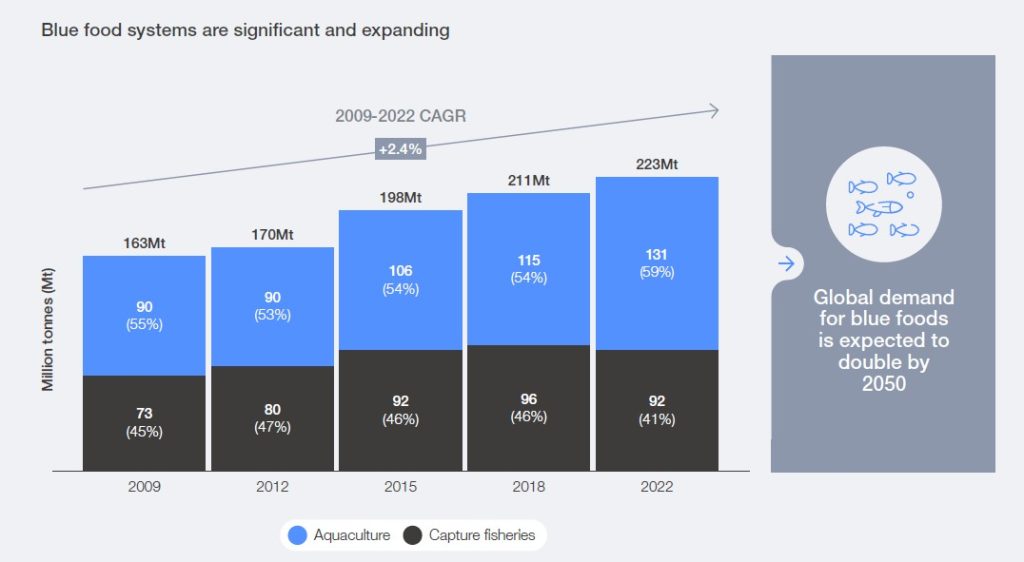
Blue food includes fish, shellfish, crustaceans, seaweed, and other aquatic organisms from marine, freshwater, and brackish water systems, and is an important component of the global food system. Blue food covers both aquaculture and wild fishing, with an annual production of over 200 million tons and a workforce of over 60 million people, providing 15% of the global population with nutrition. Blue food is rich in animal protein and essential micronutrients, and its price is usually 30% cheaper than other protein sources.
Blue food has relatively better sustainability, with greenhouse gas content reduced by over 80% compared to other protein sources, and requiring less freshwater and land for production processes. Due to different responses of aquatic organisms to climate events, the food system composed of blue food is more stable. In addition, blue food can bring ecological benefits and achieve carbon sequestration function.
Challenges Faced by Blue Food
The World Economic Forum believes that the blue food industry faces the following challenges:
Scale production: 60% of the cost of global blue food production is feed cost. In many regions, feed production capacity is limited, and the cost of using imported feed is high. The conversion rate to using local feed is low. In the absence of efficient cold chain, transportation, and processing capabilities, blue food will lose one-third before reaching consumers. In addition, the economic losses caused by global aquaculture diseases reach $6 billion annually, while also posing environmental risks.
Supporting facilities: The growth of the blue food industry relies on supporting systems such as finance, infrastructure, and supply chain. The geographical dispersion of products and the lack of production training for labor force affect the improvement of production capacity and quality. Some merchants have limited opportunities to obtain low-cost financing and may fall into a cycle of low input and low output due to the constraints of early costs.
How to Promote Blue Food Development
The World Economic Forum provides two suggestions for the development of the blue food industry:
Innovation in products, technology, and business models: In terms of investment, developing alternative feed to reduce the risk of disease in aquatic animals. Expand the supply of water resources, electricity, and agricultural infrastructure in production, and improve the sustainability of fishing activities. In terms of processing, provide refrigeration facilities, promote local processing, and reduce product losses. In terms of supply chain, establish logistics and traceability systems, and develop circular economy to reduce waste emissions.
Favorable policy, financial, and cooperative environment: In terms of policy, countries can incorporate blue food into their food security, climate, and investment strategies. In terms of finance, provide patient capital and mixed financing to expand the infrastructure for small-scale producers. In terms of skills, provide more professional skills training and connect public institutions, investors, and communities.
Reference:
Investing in Blue Foods: Innovation and Partnerships for Impact