2024 Global Enterprise Transition Report
The Transition Pathway Initiative (TPI) releases its 2024 Global Enterprise Transition Report, which aims to summarize the progress of the top 1000 listed companies with the highest carbon emissions in addressing climate change.
The Transition Path Initiative believes that investors’ attention to climate risks is increasing day by day. The total market value of the listed companies involved in this report is about 39 trillion US dollars, accounting for 35% of the total market value of global listed companies. Therefore, it is worth paying close attention to.
Related Post: Introduction to the Corporate Transition Classification System by Climate Bond Initiative
Global Enterprise Transition Situation
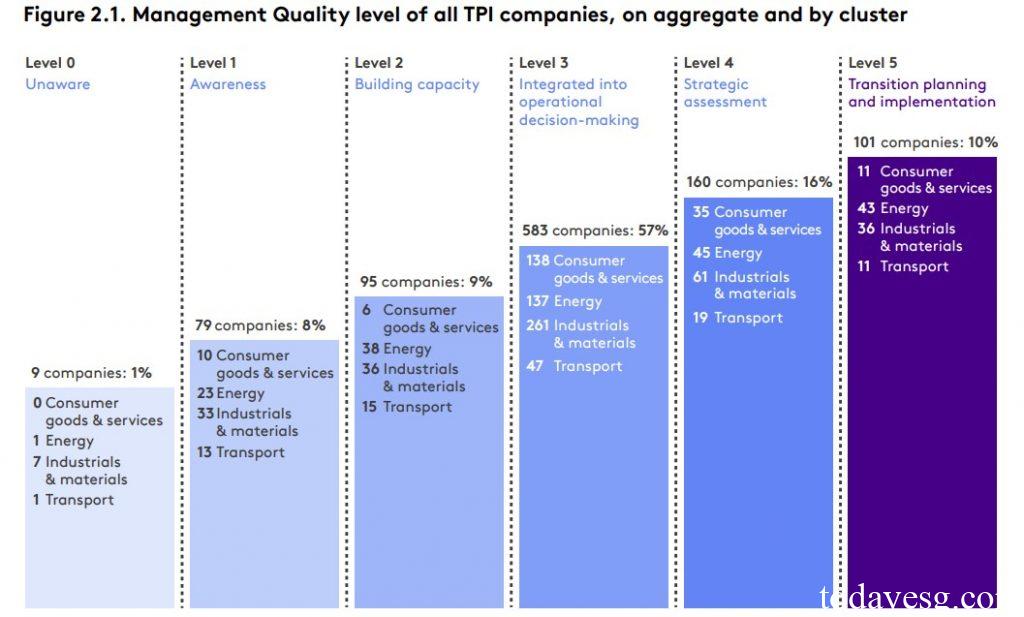
The Transition Pathway Initiative analyzes corporate carbon management based on its TPI Management Quality Framework, and analyzes the management quality levels of different enterprises into six different levels. 57% of enterprises are at the third level, which is the average level of carbon management. These enterprises have identified climate change as a business risk and opportunity, set carbon reduction targets, and disclosed their Scope 1 and Scope 2 carbon emissions.
According to analysis, there are 18% of enterprises below the third level, and 82% of enterprises above the third level. 10% of enterprises are located in the fifth level, and these enterprises have a strategic understanding of carbon emission risks and have incorporated them into their business strategies. From industrial perspective, the power industry has the highest rating in carbon management quality, while the materials industry has the lowest rating. Although there are differences between industries, more than half of the companies in each industry have taken climate change into consideration and formulated policy commitments.
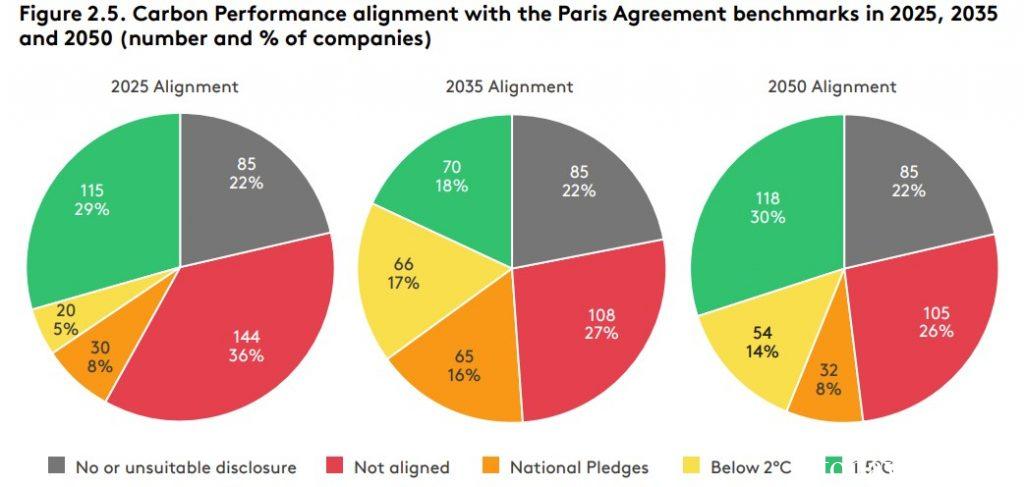
In order to measure the consistency of corporate emission trajectories with the Paris Agreement, the Transition Pathway Initiative evaluates the carbon performance of over 400 high carbon emitting companies in 2025, 3035, and 2050, in order to compare short-term, medium-term, and long-term carbon emission targets. In the long run, the proportion of companies whose decarbonization trajectory meets the Paris Agreement’s 1.5 degree Celsius warming target is the highest, reaching 30%. By 2025, 36% of businesses are not be able to achieve a warming trajectory in line with the Paris Agreement, and this number decreases to 27% by 2035. From an industry perspective, the decarbonization trajectories of the aviation industry in the short term and the automotive industry in the long term are most in line with expectations.
Enterprise Transition and Climate Action
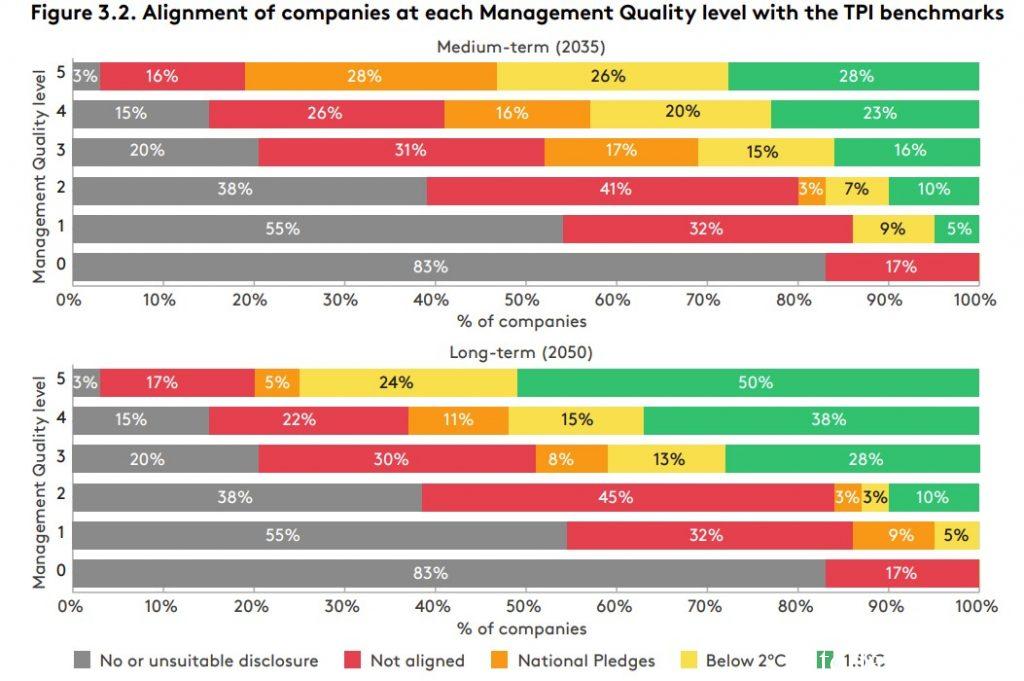
In order to gain a comprehensive understanding of corporate climate action, the Transition Pathway Initiative analyzes the relationship between the quality of corporate carbon management and its carbon performance. Research has found that companies with higher management quality in 2017 experience the greatest reduction in carbon emissions intensity in the future. For example, companies with a management quality level of four see a 9.6% decrease in carbon emissions intensity over the next four years, which is 2.7 times that of companies with a management quality level below three. However, this pattern has gradually weakened in recent years’ data, so there is only a positive correlation between management quality and carbon performance in the short term. However, this relationship is still closely related to factors such as sample size, carbon emission measurement methods, and measurement time.
In the medium to long term, 74% of enterprises with a management quality level of five will achieve carbon emission targets in compliance with the Paris Agreement by 2050, while this proportion decreases to 53% in enterprises with a management quality level of four. This proportion continues to decrease to 28% in enterprises with a management quality level of three, and to 10% in enterprises with a management quality level of two. The pattern is also reflected in the mid-term results of 2035. This indicates that the relationship between carbon management quality and carbon performance is closer in the long term than in the short term.
Regional Differences in Enterprise Transition
The Transition Pathway Initiative believes that external factors of a company, including regulatory environment, industry structure, corporate governance, etc., will affect its climate action. In terms of regions, 46% of companies in Europe are located in the fourth and fifth level of management quality, 31% in Australia, and 24% in Japan. In terms of carbon performance, companies in Europe, Australia, and Japan have the highest proportion of achieving the Paris Agreement decarbonization pathway by 2050, at 66%, 64%, and 56%, respectively.
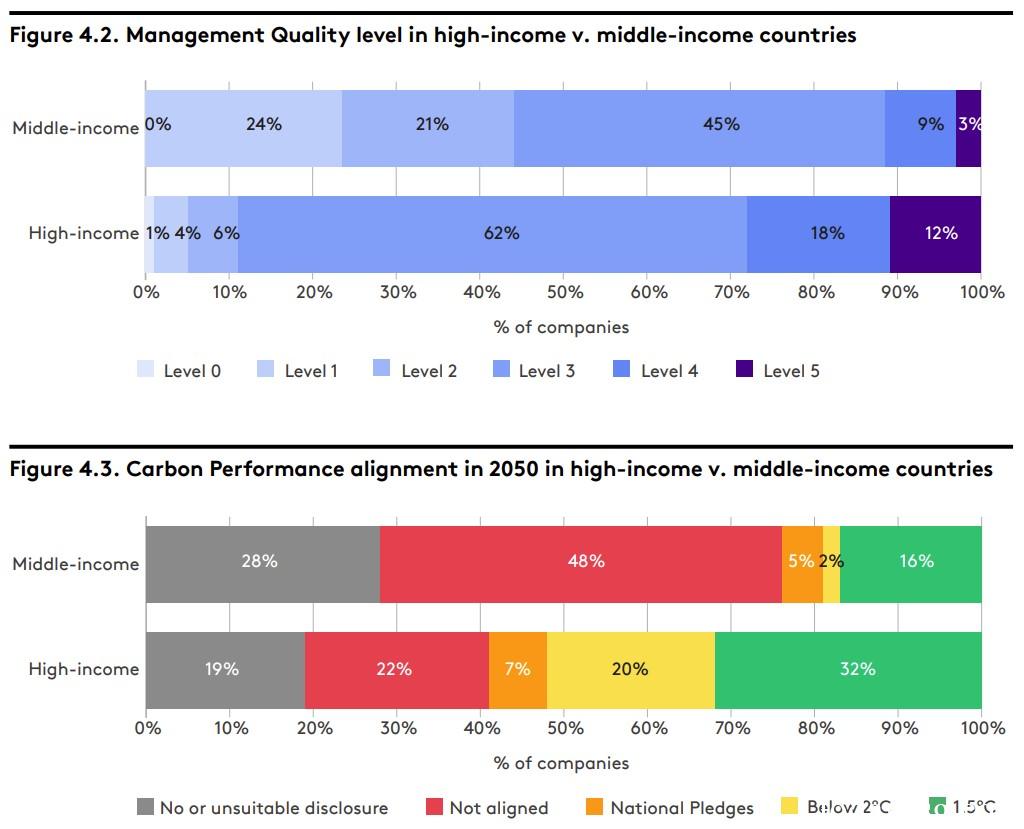
The Transition Pathway Initiative divides different countries into high-income and middle-income groups based on World Bank data to measure their performance in carbon management quality and carbon performance. 30% of high-income countries are located in the fourth and fifth levels of carbon management quality, while the proportion for middle-income countries is 12%. 32% of high-income countries will achieve a decarbonization trajectory in line with the 1.5 degree Celsius warming target by 2050, while the proportion for middle-income countries is 16%. The Transition Pathway Initiative found that factors such as national climate regulations, carbon pricing systems, carbon prices, climate strategies, and climate information disclosure all have a significant impact on the carbon management quality and carbon performance of their enterprises.
Reference:
Transition Pathway Initiative State of Transition Report 2024