2025 Impact Investing Market Report
The Global Impact Investing Network (GIIN) releases 2025 Impact Investing Market Report, which aims to summarize the development of the global impact investing market.
This report analyzes investing motivations, asset allocation, and the financial performance of 429 financial institutions. The global impact AUM has achieved a compound annual growth rate of 21% in the past six years.
Related Post: Global Impact Investing Network Releases 2025 Asset Owner Impact Investing Report
Introduction to Global Impact Investing Market
The total impact investing scale of financial institutions in the report is 448.2 billion US dollars, accounting for 3% of the total asset management scale of these institutions (13.1 trillion US dollars). The average annual growth rate of impact investing is 21%, which is higher than the growth rate of total asset management scale (5%). In the past two years, under market fluctuations, the scale of impact investing has increased by 11%, while the total asset management scale has decreased by 6%. Impact investing is concentrated among large investors, who account for 24% of the sample size and manage 84% of impact investing assets.
For impact investing, 58% of investors prioritize financial returns over impact performance, with 32% of large investors prioritizing financial returns and only 10% of small investors. 27% of small investors consider impact performance as their top priority, while only 14% of large investors consider impact performance as their top priority. Considering the classification of asset owners and asset managers, 24% of asset owners value impact performance, while 15% of asset managers value impact performance.
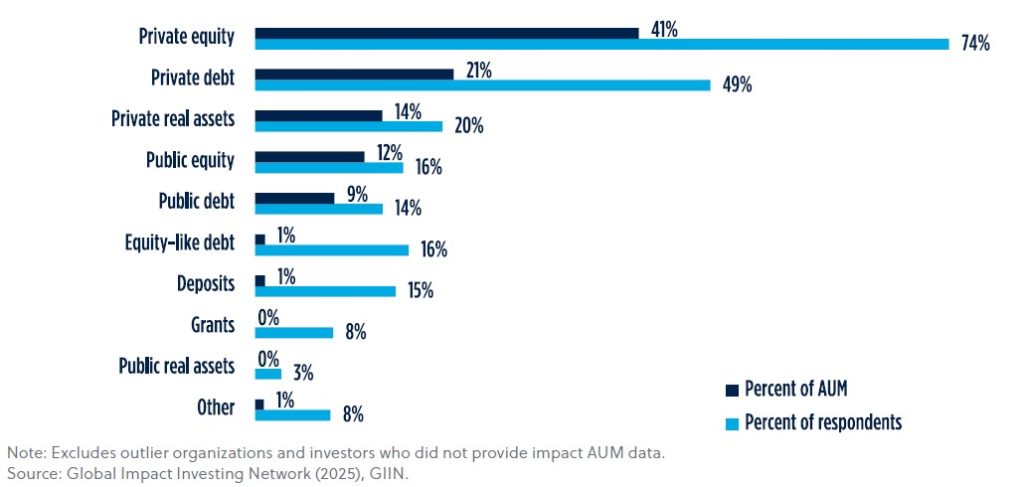
In terms of investing methods, 74% of investors choose direct investing, and 26% of investors choose indirect investing through funds and other means. The most used investing tools by investors include private equity (41%) and private debt (21%), while the usage ratios of public equity and public debt are 12% and 9%, respectively. In terms of investing regions, North America (33%) and Europe (15%) have relatively high proportions. In terms of industry classification, the finance industry (21%) and the energy industry (20%) rank in the top two.
Climate investing is a key focus of impact investing, with 86% of investors investing in climate solutions, with climate change mitigation (67%), climate resilience (60%), and climate change adaptation (58%) being the main directions. Investors mainly focus on the potential to avoid carbon emissions (63%) and reliable climate taxonomy (42%) when evaluating climate projects.
Outlook on Global Impact Investing Market
The report finds that the challenges faced by the impact investing market include:
- Industry: 66% of investors believe that the market lacks clear guidance and regulation, and 65% believe that investing lack appropriate exit channels. 58% believe that the demand for impact investing from customers is decreasing.
- Data: Investors consider data collection (93%), data quality (93%), and data cost (92%) to be the main challenges, with a higher proportion of small investors.
- Macro: Inflation (91%), economic fluctuations (88%), and interest rates (88%) are relatively high, and negative market attitudes towards ESG (67%) are also important factors.
The Global Impact Investing Network believes that the market can promote the development of impact investing through the following ways:
- Expand investing risk exposure to emerging markets and focus on initial investing in impact investing projects.
- Use standardized tools to provide data verifiability, comparability, and transparency.
- Increase the allocation of key areas such as climate solutions, considering the long-term impact on performance.
Reference:
State of the Market 2025: Trends, Performance and Allocations