
LSEG ESG Scores System
The London Stock Exchange Group (LSEG) releases a new ESG Scores system aimed at providing a more stable, transparent, and data-driven ESG Scores system.
The London Stock Exchange believes that with the expansion of the ESG market and the strengthening of regulatory requirements, the traditional ESG Scores system’s assistance to investors’ asset allocation and risk management is declining, and there is a need to update the old Scores system.
Related Post: International Capital Market Association Releases ESG Ratings and Data Products Report
The Importance of ESG Scores
Although investors have different attitudes towards ESG Scores, ESG Scores are still widely used in the investment process for reasons including:
- Summary of non-financial information: ESG scores can systematically extract massive, vague, and incomplete non-financial performance data into a simple and intuitive comprehensive data point, enabling investors to efficiently incorporate a wide range of non-financial information into the investment process. If this non-financial information is evaluated separately, it is often difficult to meet the investment threshold.
- A proxy variable for intangible assets of enterprises, the way in which enterprises handle ESG can reflect their attitudes and actions towards environmental, social, and governance topics, as well as their emphasis on reputation risk and regulatory risk. ESG scores can help investors observe a company’s performance in these areas and measure intangible assets that may be crucial for long-term development.
- A universal tool for investment analysis: ESG scores emphasizes material topics across different industries to obtain a comparable score, which can be applied in investment screening, monitoring, comparison, and other processes.
Introduction to LSEG ESG Scores System
The LSEG ESG scores system consists of three modules:
Module 1: ESG Theme Scores
ESG theme Scores is the foundation of the Scores system. The exchange summarizes 12 core ESG themes by analyzing the ESG topics covered by major ESG data providers, including climate change, energy use, biodiversity, etc. Based on the actions taken by enterprises to manage ESG thematic risks in their operations and supply chains, specific scores (0 to 5) are obtained. For a company, after evaluating 12 core themes, it can obtain 12 ESG theme Scores.
Module 2: ESG Core Scores
The ESG core score aggregates 12 ESG thematic scores to obtain three ESG scores: environmental, social, and governance, as well as an overall ESG score. Enterprises will be assigned to one or more material groups based on their industry and business activities and obtain a material matrix. These groups and matrices are used to calculate ESG core Scores, helping investors understand the driving factors behind Scores and conduct meaningful cross-industry and cross market comparisons.
Module 3: ESG Scores Plus
ESG score Plus is a supplement to the ESG core score. As the data used for ESG core score mainly relies on corporate disclosure, ESG score Plus introduces supplementary information on this basis. For example, sovereign ESG risks, ESG dispute events, proportion of green revenue, proportion of ESG debt, etc. These pieces of information are converted into a standardized score and included as adjustment items in the calculation.
Application of LSEG ESG Scores System
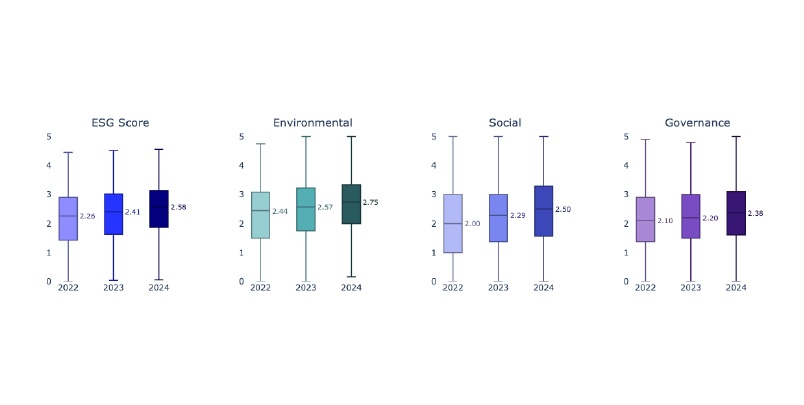
The London Stock Exchange analyzed 2620 large and medium-sized companies in the FTSE All World Index using a new ESG scores system and found that 60% of the companies scored between 2 and 3.5 points, 7% scored below 1 point, and 2% scored above 4 points. In the past three years, the median ESG score of enterprises has increased from 2.3 to 2.6, with Chinese enterprises showing the fastest improvement in ESG score (median increase of 0.5).
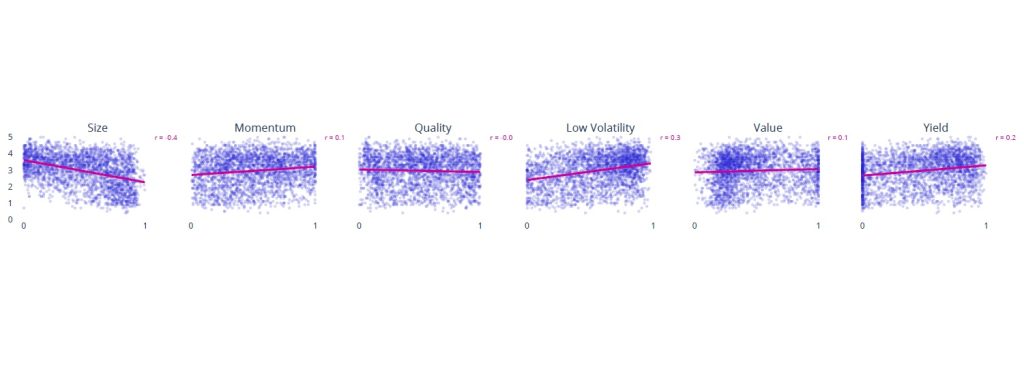
There is a negative correlation (-0.4) between ESG score and enterprise size factor, indicating that large enterprises are more likely to obtain high ESG scores. The ESG score is positively correlated with the volatility factor (0.3), indicating that companies with lower scores typically have higher volatility. The low correlation between ESG Scores and momentum, value, and dividend yield factors indicate that ESG Scores contain information that has not been fully explained by traditional factor models.
Reference: