2025 Global Corporate Net Zero Report
Accenture releases 2025 Global Corporate Net Zero Report, which aims to summarize the net zero actions taken by global enterprises.
Accenture analyzes the world’s top 4,000 companies by revenue and created a net-zero database based on their public filings. These companies are primarily from Europe (1,088), North America (1,342), and Asia (1,343), with 74% being publicly listed and 25% being private.
Related Post: SBTi Releases Net Zero Standard for Financial Institutions
Global Corporate Net Zero Development
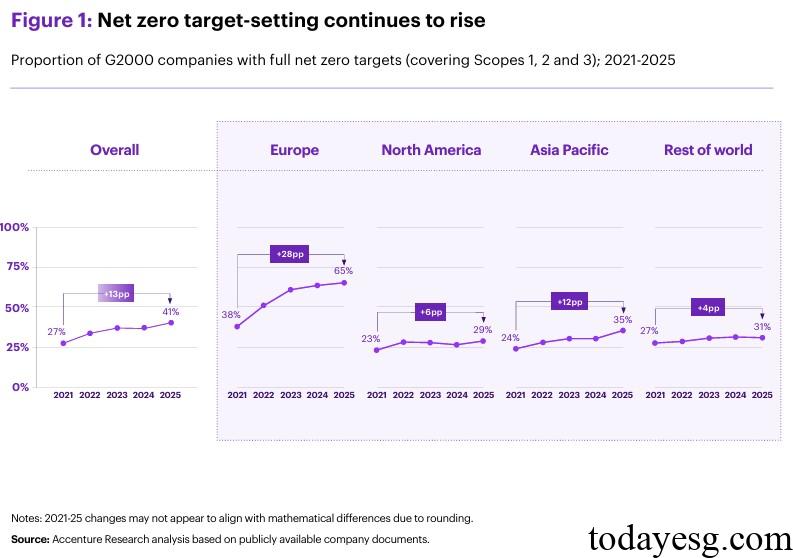
In 2025, the global corporate net-zero initiative continued to gain momentum, with 41% of companies establishing net-zero targets across their entire value chains, marking a 13-percentage-point increase from 2021. Analyzing by region, Europe, Asia, and the Americas accounted for 65%, 35%, and 29% respectively. 81% of companies are collaborating with value chain partners on decarbonization projects, and 71% have joined industry decarbonization organizations. Since 2016, large enterprises have achieved annual revenue growth of 7% while maintaining their carbon emissions unchanged. 75% of companies have reduced their carbon emission intensity, and 50% have decreased their absolute emissions.
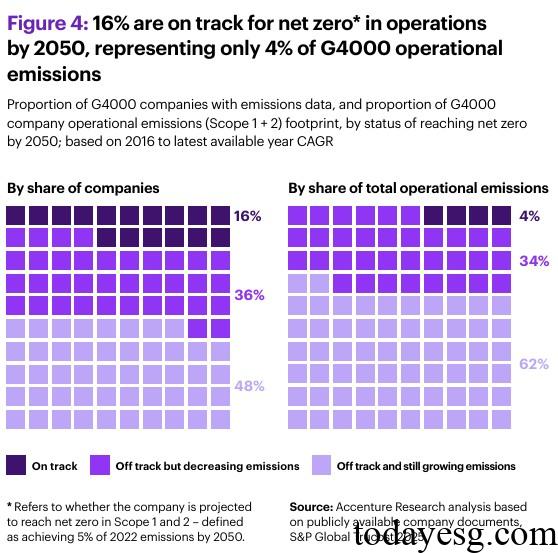
Despite progress, only 16% of companies, whose carbon emissions account for only 4% of the total sample, are on track to achieve net-zero by 2050 at the current decarbonization rate. 73% of companies have set Scope 1 and Scope 2 net-zero targets, nearly doubling compared to 2021. Among those companies that have set net-zero targets, only 42% have developed detailed transformation plans, indicating that companies still need clearer action plans, investment plans, and governance structures.
Enterprises have shifted decarbonization from a marginal measure to a core business, as reducing carbon emissions can drive innovation, enhance operational efficiency, expand investment opportunities, and mitigate regulatory risks. 90% of enterprises have linked decarbonization to business value, yet only half have disclosed climate-related investments, and one-third have disclosed sustainable revenue. These disclosures can quantify enterprises’ decarbonization actions and obtain support from investors, regulators, customers, and employees.
Accenture believes that the following factors can drive enterprises towards net-zero actions:
- Clear goals and governance mechanisms: Net-zero goals and governance can assist enterprises in achieving their objectives year by year.
- Extensive and effective decarbonization measures: Enterprises need to adopt a series of measures in their operations and value chains, rather than relying on a single action.
- Strong business case transparency: High transparency can help investors and regulators see the value of decarbonization.
- Digitalization and cooperation factors: Technology and cooperation can help enterprises achieve decarbonization faster.
Reference: